Physics


The Colorado School of Mines Board of Trustees has awarded promotions and/or tenure to 19 Mines faculty members for the 2022-2023 academic year. Additionally, five Mines faculty members were granted
Sustainable Energy@Mines (SE@M) is a fully customizable pathway of distinction, combining classroom instruction, co-curricular and extracurricular experiences alongside opportunities for community building that students can integrate with their other academic studies.
A new $15 million interdisciplinary research institute led by Colorado School of Mines aims to create new theoretically grounded and experimentally validated approaches and tools to design and discover dynamical materials and structures while solving long-standing scientific challenges in the dynamical response of materials.
“Quantum technologies are poised to revolutionize how we compute, communicate and sense and this requires engineers that have an interdisciplinary education,” Mines' Peter Aaen said.
The Rocky Mountain Industrial Assessment Center will result in shared courses where students from both institutions can learn about how to improve energy efficiency in the building and manufacturing industry.
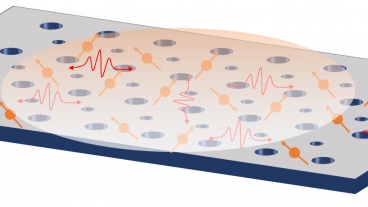
Researchers will develop a first-of-its-kind quantum simulator that could be used to develop novel materials and, in the future, lead to the development of a high-performance quantum computer.
A new quantum engineering minor at Colorado School of Mines will give undergraduate students the opportunity to gain exposure to quantum theory and hands-on experience with relevant hardware and prepare for careers in the rapidly evolving field of quantum technology.
“Hybrid perovskite photovoltaics are one of the most promising new technologies and have made gains in champion cell performance at astronomical rates. However, stability remains a show-stopper for the technology,” said Angus Rockett, professor and head of the Metallurgical and Materials Engineering Department.

In findings published last week in the journal Physical Review Letters, an interdisciplinary team led by Mines and Lawrence Livermore National Lab demonstrated the power of using nuclear decay in high-rate quantum sensors.
A Mines alumnus, Squier was recognized for his “seminal contributions to ultrafast optical technology, including the first ultrafast Ti:sapphire regenerative amplifier," among other accomplishments.