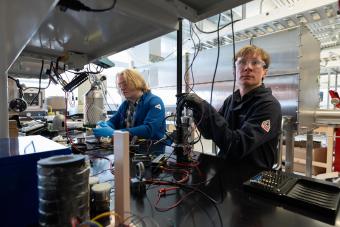
John-Austin Little, left, and Austin Arvidson work on FUSE, a system they created that uses acoustic levitation to synthesize materials.
Acoustic levitation – using sound to float an object – might seem like science fiction, but it’s essential to a new system designed by two undergraduate Mines students with help from the Labriola InnoHub E&I Prototyping Fund.
The Floating Ultrasonic Synthesis Environment, or FUSE for short, uses sound to create a contact-free environment in which to synthesize new materials, with the goal of speeding up the synthesis process while also reducing the possibility of error or contamination.
It’s a lofty idea driven not by classroom work but student curiosity – which is exactly why the ProtoFund exists. The semester-long program provides student-led teams up to $500 in funding to build prototypes, connects teams with mentors and provides access to resources and tools to bring their ideas into reality. Qualified teams can receive up to $2,000 in a second round of funding.
“If you look up acoustic levitation, or a lot of stuff similar to what we're trying to do, there's really not a whole lot of other scientific literature on it, especially in materials science. There's sort of that aspect of, I don't know a whole lot, but also it seems like science also doesn't know a whole lot,” said Austin Arvidson. “It forces you to learn. You could give up, but why don't you learn something new?”
Arvidson and his co-inventor, John-Austin Little, met while working together on a vertically-integrated research project focused on studying quantum materials. Their concept is novel: An open-sided container about the size of a 3D printer that could be used as a contactless way to synthesize materials. Instead of using an ampoule or another standard container -- which runs the risk of having the samples react with the container material -- the open-concept system reduces the risk of contamination. One of the biggest advantages to FUSE is speed. Materials synthesis is a common lab practice, but it usually involves multiple people and a lot of time. FUSE could produce the same results, much faster. Little estimates that one FUSE system could process up to 40 samples a day; when using standard lab practices, the same number of samples could take a fully staffed lab about a week.
All year, Little and Arvidson have been working on their prototype, refining the system and testing it with different materials. Their academic backgrounds are nicely complementary for this project – Little is majoring in engineering physics and Arvidson in metallurgical and materials engineering. And while Little understands how the physics of their system supports material synthesis, Arvidson understands materials and the electronics of the system and works on that aspect.
“We always joke that he’s an MME trying to be a physicist and I’m a physicist trying to be an MME. But it does really make for an awesome team,” Little said.
Both admit they’re not experts on acoustic levitation, but figuring out the challenges of the unknown has been fulfilling. Possibly being the researchers to break new ground is an exciting prospect.
“We're doing old school science, which means we actually have to discover something by just sort of thinking about it and then messing around and seeing how it goes. It's fun," Little said.
Aerospace, automobiles and beyond
What kind of materials would work best in FUSE? Little said anything that requires a heating process can be synthesized in FUSE.
“Really anything in any industry that requires some novel material, whether it's the computer chips in your laptop and the metal in your car, all of those are sort of open playing fields,” Little said. “Anything that we can either melt or heat and get something useful out is a potential candidate for the system.”
Aerospace is a prime example. Alloys used in that industry need to withstand extreme amounts of heat because of the high temperatures jet fuel can reach. FUSE could be used to combine different materials to create custom alloys that work well under extreme heat without expanding or contracting. Little said he could also see the system being used in the energy industry, creating nuclear fuels or battery materials. The list of possibilities is long.
“No one has really been able to float anywhere near as much weight as we're theorizing that we can with our models and simulations. They've all just been much smaller amounts, like a little small drop of water, or other things like that,” Arvidson said. “How you scale this up to float more mass is still an unanswered question,” Arvidson said.
Little and Arvidson still have time to work on the project while at Mines – both are about to complete their first year of undergraduate studies. They plan on continuing to study acoustic levitation and work further on getting scales they created for FUSE into a standalone product, while also refining and iterating the FUSE system.
Because of the ProtoFund and other E&I resources and support at Mines, they’re off to a strong start. Check-ins with ProtoFund mentors have helped them consider possible uses for FUSE they hadn’t before. The McNeil Center for Entrepreneurship and Innovation provided advice on the business aspect of their project and arranged for Little and Arvidson to present their ideas to Mines President Paul C. Johnson and Provost Stefanie Tompkins, as well as other experts.
“It would be impossible to do this without the resources provided by the ProtoFund and the Labriola Innovation Hub,” Little said. “Pull yourself up by your bootstraps is fine, but someone has to show you the bootstrap, and a lot of people have been helping us find those bootstraps. Otherwise, hours and hours of hard work really would just be us banging our head on the wall, and there wouldn't be all of the eureka moments and the progress.”

About Mines
Colorado School of Mines is a public R1 research university focused on applied science and engineering, producing the talent, knowledge and innovations to serve industry and benefit society – all to create a more prosperous future.