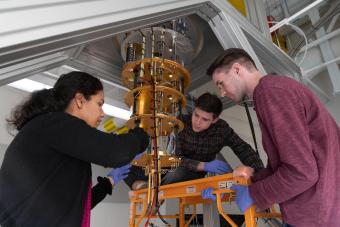
PhD students Sam Saiter, center, and Bradley Lloyd, right, work with Physics Associate Professor Meenakshi Singh on the dilution refrigerator in one of the quantum labs on the Mines campus.

By Jen A. Miller, Special to Mines Research
In 2025, physicists all over the world celebrated the Year of Quantum Science and Technology, recognizing the impact of 100 years of quantum mechanics. Just about all modern technologies rely on quantum mechanics, such as computers, smartphones, GPS or MRI machines, to name a few.
At the foundation of quantum mechanics is a collection of strange phenomena such as superposition and entanglement, unlike anything encountered in our everyday lives. The next quantum breakthroughs will emerge from our ability to engineer microscopic quantum systems able to tap these extraordinary powerful properties to create entirely new game-changing sensors, computers and communication devices. While the field is still relatively new, the potential it promises could be exponential, with scientists across universities and industries exploring how such devices could be used in everything from materials science to drug discovery to finance.
At the same time, Mines has been moving ahead with a new mission of preparing engineers and scientists for Quantum 2.0, the next revolution this technology is poised to bring by harnessing the power of quantum computing, sensing and communications, which can solve problems in ways that are unimaginable with today’s technology.
According to the Quantum Economic Development Consortium, there were more than 6,000 companies working in quantum as of 2024, with 513 businesses solely focused on quantum (known as pure-play companies). The U.S. has the most pure-play quantum companies in the world with 148—and Colorado has become the nation’s quantum hub.
But to fully capitalize on the technology’s opportunities and promise, the expanding quantum industry needs skilled engineers to fill jobs and help lead the new wave of technology and systems—which is where Mines comes in.
“[Colorado] could become the nexus of the country’s quantum industry, provided we find ways to nurture the already existing ecosystem,” said Fred Sarazin, director of Quantum at Mines and physics department head. “One of those things we can do is provide Mines graduates to take on those quantum jobs in Colorado."
With 150 years and counting of close ties to industry, Mines is an ideal university to meet the demand. “Mines is uniquely positioned because we have historically had all those ties to industry,” said Sarazin. “This allows us to be a lot more aware of what the demands are and what companies need.”
Because of those connections, industry partners were consulted from the get-go as Mines was in the planning stages of creating a graduate quantum degree program. In 2020, Mines became one of the first universities in the U.S. to offer a quantum engineering master’s degree, developed from a direct industry need.
“We are hearing from industry that many roles don’t require a PhD but they call for people who are quantum aware and who understand how technologies like lasers and cryogenics come together to run quantum systems,” said Meenakshi Singh, director of the Quantum Engineering Program at Mines.
Those industry partners included Colorado quantum companies, as well as those who are based elsewhere, with the hope that perhaps they may open an office or launch a subsidiary within the state if they had the right workforce and partners to make that a feasible option.
“The conversations were about knowing what the needs were and how do we fill them,” Sarazin said.
In responding to industry demands, Mines’ smaller size is an asset, allowing the university to be more nimble, Sarazin said. It helps that many Mines alumni are already working for quantum companies, too. Most people working in the industry right now don’t have a dedicated quantum degree, and it’s not always a requirement to work in the industry.
“You’re going to find physicists, computer scientists, electrical engineers, mechanical engineers, all kinds of graduates already at work,” Sarazin said, and includes people with bachelor’s, master’s and doctoral degrees.
“The idea of developing specific quantum degrees is to better fit the needs of that industry. But in the meantime, they can get strong graduates from Mines with a strong overall background, but on-the-job training is required, which is not always ideal,” Sarazin said.
The Quantum Engineering master’s degree at Mines was specifically designed to give students hands-on skills that are essential to build the quantum future, Singh said. For example, Mines students in the quantum hardware track learn the techniques used to make quantum chips in a microfabrication course that is taught in the cleanroom. Most quantum technologies also need to be cooled down to very low temperatures to enable their performance—which is why Mines students gain experience with cryogenics in a quantum technologies course.
The program was originally capped at 40 students, but demand has grown so much that, in 2025, 55 students were enrolled in the program. “It has been very successful, and we are working to grow the capacity for the program,” Singh said.
Building on this momentum, Mines just launched an undergraduate degree in quantum systems engineering. It is the first bachelor’s-level program fully dedicated to quantum in the country, said Sarazin.
Students in the program will learn how to design, integrate and manage entire quantum-enabled systems, bridging the gap between quantum theory, hardware and full-scale implementation. They will not only understand basic quantum principles but will engineer individual components, integrate them into functioning systems and consider how that system is deployed in real-world applications.
Having students trained across the degree spectrum anywhere from a bachelor’s degree up to a PhD in quantum is critical for the growth of the quantum industry, especially at the startup level. Right now, many startups are recruiting skilled engineers who are not specialized in quantum. Providing that comprehensive specialization at Mines will change that.
New quantum companies are “going to need quantum systems engineers to develop a product from R&D to field deployment,” said Sarazin.
Mines also offers a certificate program to industry professionals who want to upskill in quantum—another direct suggestion from industry partners.
“If you hire fresh engineers in quantum, they need the senior people overseeing them to understand what it is that they are overseeing,” said Singh. “Industry professionals can get quantum comfortable with the technology through this program.”
Explore more of how Mines is building the quantum workforce and driving quantum innovation at https://www.mines.edu/quantum-research.

About Mines
Colorado School of Mines is a public R1 research university focused on applied science and engineering, producing the talent, knowledge and innovations to serve industry and benefit society – all to create a more prosperous future.