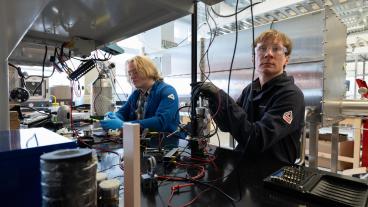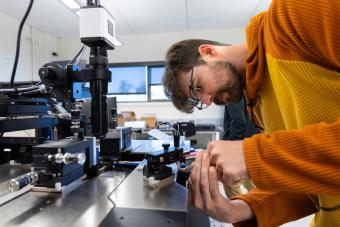
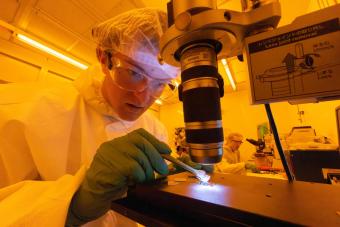
Electrical engineering graduate student Steffen Krossuses a visible laser to align to a microwave photonic chip.
The Quantum 2.0 race is on, and Colorado School of Mines is ready to compete.
While the so-called second generation of advancement in quantum is increasingly becoming a crucial part of technological progress around the world, Mines has long been ahead of game in quantum education. The first quantum engineering graduate program in the nation launched at Mines more than five years ago and, currently, the university is still one of just a handful of institutions that offers a graduate degree in the field.
“We’re really well positioned in quantum because, especially through the Physics Department, we started to invest specifically in the field about 10 years ago,” said Fred Sarazin, department head and professor of physics who is leading quantum efforts at Mines. “We created one of the very first quantum engineering master’s degree programs in the country.”
Soon, Mines will have a unique quantum offering for students with a new undergraduate degree program—the first of its kind in the United States.
It’s an ambitious undertaking, but Mines has all the right elements to both spearhead and lead the way in undergraduate quantum education. The bachelor’s degree program, which will focus on quantum systems engineering, aims to begin enrolling students in fall 2026.
“We expect the program to have national appeal, so there could be students from around the country looking to come to Mines specifically to study quantum,” Sarazin said. “There’s no other program like it in the nation.”
Because the future of quantum is interdisciplinary, the program will draw on the strength of Mines’ programs across departments—from physics, computer science, electrical and mechanical engineering, and engineering design to start—to build a comprehensive experience for those enrolled. In speaking with current Mines students, Sarazin said he found they have strong, broad interest in quantum-related jobs after graduation.
But he says the demand is coming not just from students who are interested in pursuing a career in quantum. Industry is hungry for more talent, and a lot of those companies are right here in Colorado.
“It turns out Colorado has the highest concentration of quantum companies anywhere else in the country,” Sarazin said. “There’s a lot of expertise available with so many quantum and quantum-adjacent companies based here. Colorado owns a significant fraction of the supply chain, so those companies are going to need a workforce.”
A Golden location
According to Elevate Quantum, a regional consortium of more than 150 organizations in Colorado, New Mexico and Wyoming, current efforts in the Mountain West are leading the way—the area contributes 3,000 commercial quantum jobs and is the home to about 50 percent of the U.S.’s critical supply chain for major quantum modalities. Mines is a key partner in Elevate Quantum, as well as Quantum Commons, a 70-acre research park currently under construction that will serve as a hub for the quantum community and support the growth of quantum technologies. Quantum Commons, located in Arvada about 11 miles north of the Mines campus, will be owned and operated by Mines and is being designed and developed with Elevate Quantum partners.
Mines’ strong presence in the quantum community and ties to local industry have been instrumental in the success of the graduate program. Those local partners have also been valued partners in building the future bachelor’s degree program. Even the program’s name—Bachelor of Science in Quantum Systems Engineering—was informed by input from those leading the field, both in the United States and around the world.
“Mines has a long tradition of connecting with industry, and quantum is no different,” Sarazin said. “Those partnerships are why we are focusing the program on preparing students to be industry-ready engineers that basically understand the whole process from start to finish, front to back. They’ll be able to work equally well with both research and development people on the physics as well as the technicians building the products.”
Trusted industry partners
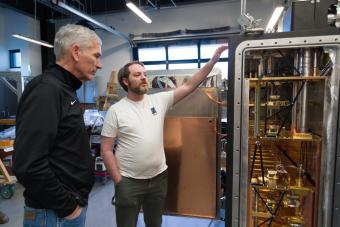
Corban Tillemann-Dick, founder and CEO of Denver-based Maybell Quantum Industries, started his quantum company after leading quantum computing strategy work as a partner at the Boston Consulting Group. He said the industry has a line of sight on where quantum can take technology, and with partners like Mines, the timeline will be shorter than previously imagined.
“Mines works with industry better than any other school I’ve seen. It’s a university that works at the speed of industry,” he said. “It’s an R1 university that focuses on research and education in the way a university should but isn’t caught up in bureaucracy when trying to solve problems. Mines is a partner that understands how to build things quickly.”
Tillemann-Dick said he’s constantly hiring Mines graduates, because he finds that they not only understand quantum principles but have the hands-on experience to create solutions.
“Mines has been at the forefront of quantum,” he said. “They’re training people who know how to actually solve problems and can tackle them from lots of different angles. Mines is by far the top university we hire from because they’re teaching the right things, in the right way.”
Along with frequently hiring Mines graduates, Maybell also tests and ships dilution refrigerators at the Labriola Innovation Hub on campus. These devices can maintain the ultra-low temperatures needed to house quantum computers. Maybell initially rented space in Labriola to fill a short-term need for additional manufacturing footprint and continues to use the space even after growing their off-campus footprint because of the benefits they see from being integrated into the Mines community.
“Mines is one of the most important partners for both Maybell and Elevate Quantum,” Tillemann-Dick said. “The thoughtfulness of the work and the leadership at Mines is exceptional.”
These kinds of well-established ties with industry partners are part of what has helped Connor Denney ’23, MS ’24 chart the course of his career in quantum.
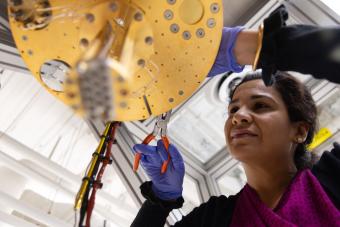
As an undergraduate majoring in electrical engineering at Mines, he joined a quantum research project led by Meenakshi Singh, associate professor of physics and quantum engineering program director. That experience led him to the master’s degree program in quantum engineering.
Now, Denney has partnered with his former Mines labmate Logan Pauli MS ’24 to start Bifrost Electronics, a Colorado-based company that will build essential components for quantum computing. He credits not only his Mines education but mentorship from Tillemann-Dick to take what started as an idea in a study session with Pauli and turn it into a business.
“[Tillemann-Dick] is very generous with his time. We knew that our investment deck was half baked, and our business plan wasn’t where we wanted it, and he was more than happy to give us critical feedback that really helped,” Denney said. Now, nearly two years later, Bifrost Electronics has secured around $4 million in investment that will help the company scale up.
Along with getting Bifrost moving along, Denney is currently working on his PhD in electrical engineering at Mines, focusing on low-temperature quantum devices, work that directly relates to his position at Bifrost as head of research and development.
The future of quantum
According to Massachusetts Institute of Technology’s Quantum Index Report, demand for quantum-related jobs began to take off in 2018, and there’s an overall upward trend of quantum skills being increasingly important in the labor market. There’s a global focus on quantum as well, and, besides the United States with its priority trending toward quantum computing, both China and Europe are emerging as future leaders in different quantum fields.
With an established graduate program, and soon an undergraduate program as well, Mines is well-positioned to educate students that will lead the way in quantum, no matter where they end up geographically.
“Mines is prioritizing quantum, and we’re well-positioned to do so,” Sarazin said. “Our master’s degree program is growing, and the bachelor’s degree is a continuation of these efforts. Quantum needs people who will understand the physics at a deeper level and then all the way through the engineering aspect and how to make a product deployable.”
“When we looked at everything we do here at Mines and where our strengths are, we know we can create a successful program for our students that will prepare them for the future of quantum,” he said.
Invoking Silicon Valley and its importance as the epicenter of the tech boom, Tillemann-Dick said Colorado will be the same kind of place for the quantum industry—and Mines will be at the forefront.
“We have the right partners to make it happen here in Colorado, and Mines is going to find itself at the very center of that in the next 50 years,” he said. “I can envision a future where people talk about Mines for quantum.”

About Mines
Colorado School of Mines is a public R1 research university focused on applied science and engineering, producing the talent, knowledge and innovations to serve industry and benefit society – all to create a more prosperous future.