For people living with diabetes, even a small wound can be a serious, lingering problem. High blood sugar can damage nerves and blood vessels, reducing circulation and sensation and slowing the body’s ability to heal. The result is often chronic wounds—like diabetic ulcers—that resist treatment and, in severe cases, lead to infection or even amputation. What’s needed is a wound dressing that can reduce inflammation, prevent infection and actively support the healing process.
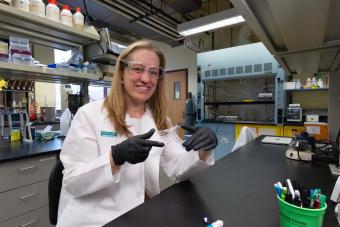
That’s the brainchild of Melissa Krebs, associate professor of chemical and biological engineering and founder and CEO of GelSana Therapeutics. What began as a scientific pursuit in her lab has evolved into a promising new approach to wound care, one designed to help calm inflammation, reduce infection risk and, in the future, even deliver therapeutics directly to the wound over time.
For Krebs, making that technology a reality for patients has meant stepping beyond the lab and into the roles of entrepreneur and CEO. We sat down with Krebs to get her insights on translating scientific discovery to real-world impact and the transition from investigator to startup leader.
Mines Magazine: How did GelSana become a business rather than just your research focus?
Melissa Krebs: Back in 2019 and early 2020, we published our first animal studies using these materials and saw strong healing results with diabetic wounds. Around that same time, I was introduced to Innosphere Ventures through the Mines Technology Transfer Office. When I shared the data and the size of the clinical need and market opportunity, they were very interested. After several conversations, they offered pre-seed funding to start a company.
I hadn’t planned on becoming a founder—I had just earned tenure and was focused on academia—but after thinking it through with my family, I realized this was an exciting path forward.
What I’ve since come to appreciate is that academic IP is usually far from being a commercial product, especially in an FDA-regulated space. It takes a committed scientific founder to move a technology from the lab bench to market. Rather than simply licensing the IP and hoping a company would take it on, starting GelSana was the most effective way for me to ensure the technology would reach patients.
MM: How do you balance being a researcher with being the leader of a new biotech startup?
Krebs: I enjoy balancing both roles because they involve different kinds of problem-solving. In research, you’re tackling highly technical scientific questions. With the startup, the challenge is figuring out how the technology fits into the market—understanding reimbursement, the competitive landscape and how to move the product forward.
What motivates me most is the chance to take something we created in the lab and bring it to patients. Being able to see that whole process through—from discovery to providing a real impact for patients—is incredibly rewarding and what drives me every day.
MM: As you started GelSana, what skill gaps did you realize you needed to address?
Krebs: One of the biggest lessons was realizing that no single person can do everything when starting a company. At the beginning, I was essentially doing everything myself, but it quickly became clear that some tasks weren’t the best use of my time or didn’t align with my strengths.
At the same time, I recognized the areas where I do add the most value. I enjoy working on the science, troubleshooting technical challenges and thinking about how the technology can scale and evolve. I also like communicating the vision of the company—sharing why the technology matters and getting other people excited about it, whether that’s investors, partners or collaborators.
Building a startup really comes down to understanding those strengths and then building a team that fills in the gaps. You find people who genuinely enjoy and excel at the things you don’t, and over time, you build out a team that can move the company forward.
MM: Was there a moment when you felt you had shifted from being a scientist to being a business leader?
Krebs: A key moment was when we raised our first seed round—and actually oversubscribed it. That was the point where I realized I could truly step into the CEO role. We had built enough of a team and a vision that people were willing to invest in the company.
Early on, I assumed I would start as CEO and then eventually hire someone else to run the company while I focused on the science. I even began interviewing CEO candidates. But I quickly realized that no one understood the technology the way I did. At that point, I decided I needed to stay in the role and grow the company myself. Looking ahead, I’m committed to staying CEO at least through our Series A round, as we move toward clinical trials. Beyond that, it will depend on the company’s trajectory. Our goal is to build toward acquisition, and if the company reaches a stage where scaling and commercialization require a different kind of leadership, I’m open to that. I regularly check in with our board about whether I’m still the right person for the role, and so far, the answer has been yes. For me, it’s about continually asking what’s best for the company and being open to evolving as it grows.

About Mines
Colorado School of Mines is a public R1 research university focused on applied science and engineering, producing the talent, knowledge and innovations to serve industry and benefit society – all to create a more prosperous future.