Mines selected for 2 Genesis Mission projects to apply AI to critical mineral exploration, nuclear energy
Researchers at Colorado School of Mines will develop new artificial intelligence-driven frameworks to address two major energy challenges in the U.S.: the search for new deposits of critical minerals and the recycling of fuel for nuclear power.
The projects, led by Sebnem Düzgün, Fred Banfield Distinguished Endowed Chair in Mining Engineering, and Jenifer Shafer, Ben L. Fryrear Presidential Chair in Energy, respectively, were awarded funding today by the U.S. Department of Energy as part of the Genesis Mission.
The Genesis Mission is a historic national initiative led by the U.S. Department of Energy, which is building the world’s most powerful integrated science discovery platform. By uniting government, industry, academia and philanthropy, the Genesis Mission is accelerating breakthroughs in energy, scientific discovery and national security through a new platform that combines AI, supercomputing, quantum systems and advanced scientific instruments.
"Our selection for two Genesis Mission projects reflects the distinctive role Colorado School of Mines plays at the intersection of AI, energy and earth science. By bringing together world-class expertise with leading partners, our researchers are developing practical solutions to challenges that matter for the nation's energy future, from securing critical mineral supply chains to advancing next-generation nuclear technologies," said Mark Van Dyke, vice president for research at Colorado School of Mines. “These projects demonstrate how university research can accelerate innovation with real-world impact."
Faster – and more cost effective – critical minerals exploration
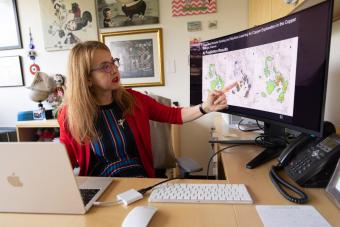
The Agentic GeoAI for Precision Mineral Exploration project – or AGAPEX for short – will bring together researchers from Mines, the Department of Energy’s National Laboratory of the Rockies (NLR), Colorado Geological Survey and Metallic Minerals Corporation’s La Plata Project to develop a new generation of AI-enabled decision support for copper and critical mineral exploration.
Currently, deciding where to invest limited exploration dollars – when geological information is complex, incomplete and uncertain – is one of the most complex challenges facing the mining industry, Düzgün said. Surface indicators of concealed mineral deposits can be subtle or not immediately recognized – and deep drill holes to confirm what lies beneath can cost a mining and exploration company $500,000 per hole.
“Mineral exploration is inherently high risk – approximately 90 percent of exploration programs do not result in an economic discovery today," Düzgün said. “Our goal with AGAPEX is to make that process faster, more transparent and more capital flow efficient.”
With AGAPEX, multimodal geoscience data, geological knowledge, physics-constrained AI, uncertainty analysis and economic decision-making will be integrated into a single Agentic GeoAI system, designed to accelerate interpretation and improve exploration decision-making. AGAPEX will also help exploration and mining companies evaluate potential next actions, such as additional geophysical surveys, geochemical sampling or drilling, and rank them based on the expected reduction in uncertainty relative to their cost.
“Rather than simply producing a mineral prospectivity map, the system is designed to reason through practical exploration questions: Where should we drill? Which additional survey is worth funding? What information would most reduce uncertainty? Why is one target more compelling than another?" Düzgün said.
NLR researchers will drive Genesis/AmSC integration while applying geoscience expertise to convert expert subsurface reasoning into structured, machine-readable logic. Ebru Bozdag, a co-PI from the Department of Applied Mathematics and Statistics at Mines, will apply her expertise in computational geophysics to integrate geophysical data into the AGAPEX framework.
Initial testing will be conducted across two contrasting geologic systems: the Arizona Copper Triangle, representing a calc-alkaline geological setting, and the La Plata Project, representing a more complex alkalic system containing copper, silver, gold, platinum, palladium and a range of critical mineral co-products currently under study.
The project team includes Mike O’Keeffe at the Colorado Geological Survey; Diana Acero Allard and Kenny Gruchalla of the National Laboratory of the Rockies; and Scott Petsel (President) and Regina Molloy (Vice President Exploration) of Metallic Minerals Corporation.
Accelerating nuclear fuel recycling
Closing the nuclear fuel cycle – recycling used fuel rather than treating it solely as waste – is essential to securing domestic fuel supplies and improving the economics of advanced nuclear reactors.
But designing, licensing and opening recycling facilities for nucleal fuel in the U.S. today is a slow and iteration heavy process, with critical analyses for safeguards and security, economics, operations and waste management fragmented across multiple tools.
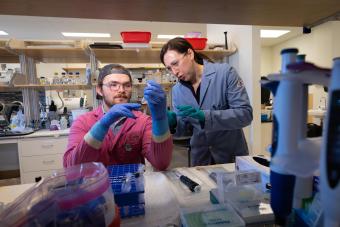
Shafer is leading a group of researchers from Mines, the Department of Energy’s Pacific Northwest National Laboratory (PNNL) and Citrine Informatics to demonstrate how AI can dramatically accelerate those analyses, reducing simulations that currently take roughly 40 hours to just one hour and multi-year efforts to about one week.
“Rather than replacing physics-based tools, we’re using AI to integrate and accelerate the entire workflow — linking simulation, optimization and decision support so stakeholders can explore far more design options in far less time,” Shafer said.
To do that, the AI-enabled “cradle-to-grave" framework will connect existing, validated modeling tools through an orchestrated network of AI agents. Analysts will be able to rapidly compare recycling and waste-form pathways while at the same time quantifying what matters most to deployment: economics (including secondary value streams such as separable isotopes), safeguards and security, and waste outcomes, such as heat loading and high-activity waste volume.
A cornerstone of the project is PNNL’s Material Inventory and Nuclear Tracking simulator (MINTs), which tracks nuclear material from individual items to the full fuel cycle. The project will extend MINTs to reprocessing facilities and pair it with AI-assisted safeguards analytics, secondary value stream screening tools and Citrine’s materials design platform for advanced waste forms.
The project team includes Eva Brayfindley, Amanda Lines and Gabe Hall of PNNL and James Saal of Citrine Informatics, with Shafer leading fuel cycle selection and the final integrated demonstration.

About Mines
Colorado School of Mines is a public R1 research university focused on applied science and engineering, producing the talent, knowledge and innovations to serve industry and benefit society – all to create a more prosperous future.