By Jenn Fields, Special to Mines Newsroom
Every critical mineral that is mined must first be found. But over the lifespan of a mining project, exploration can be a costly stage in the process, carrying significant financial risks.
At Colorado School of Mines, experts in mining and mineral exploration are taking innovative cross-disciplinary approaches to de-risk the process, solving real-world problems in critical minerals exploration by leveraging cutting-edge technologies. Their work in techno-economic analysis, mine waste reprocessing and recycling, and AI-driven exploration is increasing certainty in one of the riskiest segments of the value chain for critical minerals.
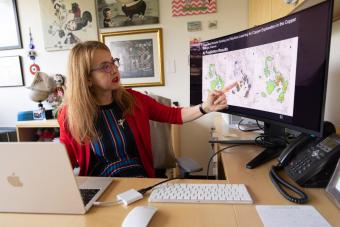
De-risking copper exploration with AI
Artificial intelligence has entered the mainstream, but Sebnem Düzgün has been thinking deeply about how to use the power of AI in mineral exploration for decades.
“When I first developed these methods for exploration almost 20 years ago, there was no interest,” said Düzgün, Fred Banfield Distinguished Endowed Chair in Mining Engineering.
Today, her research group has expanded the AI-based exploration tool she’s been refining for years for geothermal exploration to improve the odds in the discovery of copper, a critical mineral that’s in high demand for data centers, electrification and many other uses.
Copper, like geothermal energy, is a product of hydrothermal alteration processes that have surface manifestations. “When you can detect alteration processes on the surface and identify their patterns, if those match some geological model, you can tell if there’s a potential resource or not,” Düzgün said.
The AI-based method she developed uses multimodal datasets, such as satellite images, geological maps, thermal anomalies and geophysical data. And it has grown more sophisticated as technology has improved. “We now have strong algorithms that can even detect mineral signatures from low resolution,” Düzgün said.
The multimodal datasets and multiple algorithms used in her method were enriched by a cross-disciplinary team of Mines PhD students from fields ranging from computer science to exploration geology. That range of expertise is built into the AI-based exploration tool, which goes beyond probability to account for geology's contribution to the prediction.
“It’s not just putting raw data into the system and getting some results,” she said. “It’s understanding the patterns of multimodal data sets that fit geological models developed for the mineral deposits. What we’re doing is not only making a prediction—we’re also doing an explainability analysis, so we improve our understanding of geoscience in exploration geology.”
This broad analysis brings valuable information to the earliest stages of the mining process.
“The drilling process is usually extremely risky,” Düzgün said. “There’s a high likelihood of not hitting the resource. Our method is scanning large areas and identifying potential targets. Based on the probability of finding a target, geologists can either collect more data, or they can start exploration drilling. It supports exploration decisions, and it also de-risks investor decisions.”
Reducing mine waste and critical minerals imports
Elizabeth Holley is interested in the 30,000-foot view of domestic critical minerals production in the U.S.
One of the key opportunities the professor of mining engineering sees is in recovering more critical minerals from the existing byproducts at U.S. mines. Her research suggests that 90 percent recovery of byproducts from active mines could fulfill most – if not all – of the demand for elements on the U.S. critical materials list. (In 2025, there were 60 elements and minerals on the USGS critical minerals list, including the 15 rare earth elements.)
Many U.S. copper mines could recover more cobalt, and platinum and palladium mines could recover more nickel, she said. Nevada’s gold mines could recover antimony and arsenic. But at the moment, recovering these critical minerals is expensive. Since it’s not profitable for the mines, they’re discarded.
“The geological endowment is there, it’s just that it’s not economically viable to recover these minerals,” Holley said. “So the next question is, what do we need to do to change that? Our team is working on policy, as well as technical research and development, to lower the costs and recover more critical minerals.”
The interdisciplinary team she leads researching the responsible mining of critical minerals is also investigating a similar but different upstream opportunity: mine waste. Whereas byproduct recovery captures minerals before they become leftovers in the mining process, mine waste recovery captures critical minerals from the leftovers themselves.
Mines' newly launched Waste to Value Center, led by Holley, is currently leading a $67 million U.S. Department of Energy project in partnership with Element USA to build a plant capable of extracting and processing rare earth elements at scale from the byproducts of the last remaining alumina refinery in the U.S.
Located on the banks of the Mississippi River in Louisiana, the refinery’s tailings impoundments contain more than 30 million tons of “red mud”– leftovers from the alumina refining process that also include the rare earth elements dysprosium, terbium, yttrium, gadolinium, neodymium, praseodymium, samarium and lanthanum.
“The goal of the Mines Waste to Value Center is a 10 percent reduction in mine waste and a 10 percent reduction in critical mineral imports in 10 years,” Holley said.
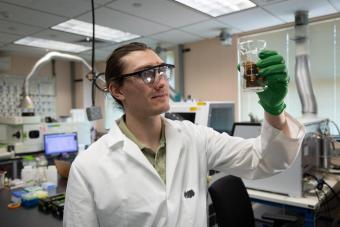
Recovering rare earths from mining impacted water
Aaron Goodman began his research at Mines as two forces intersected in the mining industry: the skyrocketing demand for critical minerals, and the growing push to pull more out of materials that have already been mined in the U.S.
“Waste as a resource has become a huge focus,” Goodman said. “There have been quite a few studies, many led by professors and students at Mines, showing that we could start to close the gap on critical minerals with mine waste.”
As a PhD student, Goodman joined a research team led by Chemistry Professor Jim Ranville investigating mining-impacted water at the Argo Tunnel, an access tunnel to legacy gold mines in Idaho Springs, Colorado. “The water coming out of the Argo Tunnel has some of the highest concentrations of rare earths in any water that we know of,” Goodman said. Though the initial research has been focused on rare earths, they also found high concentrations of cobalt and nickel, both of which are on the 2025 U.S. critical minerals list.
The current water treatment process at the Argo Tunnel makes a mineral-rich sludge that the water treatment plant discards. Goodman, now an assistant professor of chemistry at Mines, is investigating a staged and segmented process that recovers the high-value minerals by relying on a combination of adsorption and acidity shifts to drop the desired minerals out of the solution.
“We’ve been able to get this process pretty selective,” he said. “We’ve been able to get the equivalent of a low-grade ore for some minerals, and we’re just in the initial stages.”
Drawing rare earths out of mining-impacted water could turn closed and inactive mines into an untapped resource. “We have hundreds of thousands of abandoned mine features in the western U.S., and if we look at all the drainages that are currently being treated, there’s a lot of potential,” Goodman said.