By Jenn Fields, Special to Mines Newsroom
The demand for new mining engineers in the U.S. has hovered near 600 engineers every year for the past few years. But at the 14 accredited mining programs across the nation, only about 300 graduate annually.
Closing the workforce gap has been a target for faculty and industry advisors to Colorado School of Mines’ Department of Mining Engineering for a decade, and now, their efforts are coming to fruition.
As of this coming fall, Mines expects to have doubled its undergraduate enrollment in mining engineering.
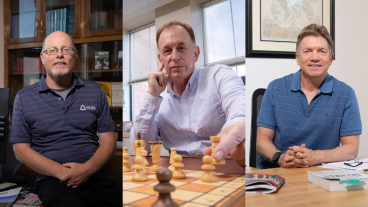
The program’s growth started with an audacious goal. When mining industry veteran Bill Zisch signed on as the J. Steven Whisler Chair of the Mining Engineering Department in 2023, he took on a directive that came with the Whisler gift to grow enrollment by half over the next five to 10 years.
That gift, a historic $7.5 million investment into the program from Mines alum and retired mining executive J. Steven Whisler M.S. ‘84 and his wife, Ardyce, arrived at a critical juncture for the mining industry, as the demand for critical minerals was increasing amid falling enrollment numbers in mining engineering programs around the country. It was a challenging environment for a big goal, even with scholarship funding from the Whisler gift providing an additional boost to the program ranked by QS World University Rankings as the No. 1 Mineral and Mineral Engineering Program in the world.
But this May, the department had already surpassed its goal for undergraduate enrollment.
“When I started, we had 101 students in the undergrad program,” Zisch said. “In May, we were at about 183, so we blew by that goal, and I think we’re going to end up closer to 200 in the fall.”
A multi-front effort
The surge in enrollment is the result of efforts on many fronts, Zisch said. The department maintained traditional recruiting efforts but also hired for the first time an outreach coordinator who is good at telling the story of the need for more minerals.
Zisch personally sought out every opportunity he could find to talk to undergrads about mining in their first or second year—before they’re deep into mechanical engineering or another major.
“Mining isn’t not always known in society, but it is essential,” Zisch said. “Everything we have comes from minerals and energy, so I think students respond to the idea of being able to make a significant impact and improvement for the betterment of society.”
Sometimes a conversation with parents on a campus tour opens the door.
“Historically, there has been a barrier to students going into mining because their parents think of it as an old, dirty industry, which is not the case,” Zisch said. “So, I share with the parents how we teach safe, environmentally sound and socially responsible mining. If the parents can understand the essential nature of what we do with critical minerals and other minerals — and that the salaries start quite high and our job placement is nearly 100 percent — that reduces the barrier. Then we get an opportunity to talk to our students.”
For Donovan Lublin, a rising senior in mining engineering, those kinds of one-on-one conversations were key. “Bruce Yoshioka gave us a tour of the Earth Mechanics Institute, and the interaction with him, and getting to see the labs, it really excited me about the industry,” Lublin said. “I felt like the people were genuine.”
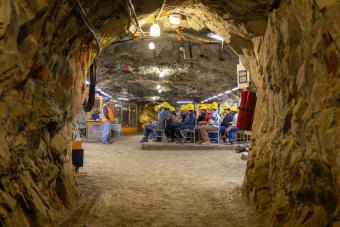
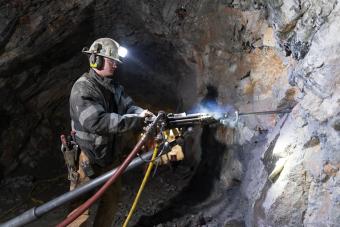
Lublin is now the president of the Mines Mining Competition Team, working a second internship with Freeport McMoRan this summer, and has completed courses and worked at the Edgar Mine, Mines’ unique experimental mine and hands-on learning laboratory.
“At the Edgar, I’ve drilled, I’ve blasted, I’ve mucked, I’ve bolted — I’ve done the whole mining cycle up there,” Lublin said. “Sometimes I just step back and can’t believe I’m doing some of these things, because it’s just so different from anything my family has done.”
A leading curriculum for the mining workforce of the future
Gaining student interest is just the first step, though. To make sure graduates arrive in the workforce ready to contribute and innovate, the department needs to offer a cutting-edge curriculum that meets industry needs.
That process began with engagement with Mines alumni and industry at all levels, said Heather Lammers, associate department head of mining engineering and teaching assistant professor.
“Over the last three years we’ve done a deep dive into the curriculum after getting the outcome of that assessment and seeing how we can take mining into the future as well as attracting more students to the industry,” Lammers said.
The department will offer several new classes this fall that arose from that assessment. A new course in data analytics will give students more hands-on opportunities with statistics so they can lead in AI and automation. A new course on mine waste, water, and closure will address how to handle the byproducts generated by mining and being good stewards of the land. “There are really no undergraduate programs that are focused on or even have curriculum in mine waste, water, and closure design, so the course we’re bringing in this fall will be a leading course in the U.S.,” Lammers said.
Another new course will cover mining sustainability. “We’re seeing a more balanced approach to the engineering solutions — that’s a shift that’s been happening over the last 15 years or so,” Lammers said. “Now there are more system controls making mining practices sustainable from a business perspective and also a community perspective. That’s driven by industry and also what our students are expecting.”
The department also launched a new minor in mineral processing and extractive metallurgy to address an innovation gap in the critical minerals value chain.
“With critical minerals, we’re really looking at the recovery of extremely small amounts of material from tons of material,” Lammers said. “We need new processing technologies and new approaches. This new minor in extractive metallurgy brings together research and teaching expertise we have already and gives our students the fundamental tools they’ll need so they can go out and innovate in the field.”
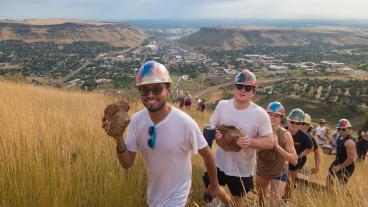
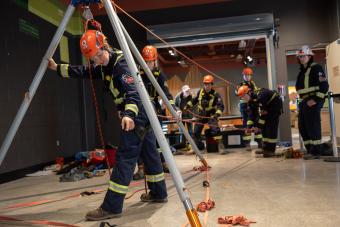
Some students are already hearing that call to innovate. Sylvia Hoyt, a rising junior in mining engineering, is focused on entrepreneurship. Hoyt is president of the Mine Rescue Team and loves an adventure — she arrived at Mines after an EMT course at the National Outdoor Leadership School and is an avid hiker and camper.
(Zisch noted that mining engineering students often share some characteristics: “They prefer being outdoors versus behind a desk, they tend to want to get their hands dirty, and they don’t mind a lot of uncertainty, which we deal with a lot.”)
This spring, Hoyt attended a conference on mineral processing to learn more about current innovations in the field.
“If you can become more efficient by taking minerals out of the rock you’re already taking out of the ground, that’s fascinating,” she said. “The critical minerals conversation is really interesting to me because there’s a lot of potential for growth, there’s room to look for efficiencies. There’s a kind of frontier there.”
To learn more about Mines' leadership in critical minerals across the full value chain, visit criticalminerals.mines.edu.