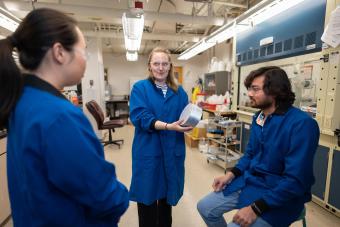
Anna Staerz, assistant professor of metallurgical and materials engineering, is developing optical sensors to monitor CO2 pipelines. Working with her are graduate students Yewon Shin and Kazi Rifat Bin Rafiq. PHOTO BY TIM MEYER/COLORADO SCHOOL OF MINES
Anna Staerz, assistant professor of Metallurgical and Materials Engineering (MME), has won an ARPA-E IGNIITE Award to develop optical sensors for monitoring high-pressure carbon dioxide (CO2) pipelines. Her research aims to detect corrosive impurities earlier, making carbon transport safer, more reliable, and more cost-effective.
ARPA-E IGNIITE supports early career scientists pursuing ideas in energy supply chain security and critical minerals, advanced nuclear energy, geothermal energy, grid reliability and security, and American manufacturing competitiveness. Awardees receive financial and technical support, helping them advance their projects from idea to reality.
Staerz’s project tackles a hurdle in Enhanced Oil Recovery and more generally in Carbon Capture, Utilization, and Storage. Classic sensors require direct contact with the gas they’re detecting, which is challenging at the high pressures used for pumping. Staerz and her team overcome this by using Differential Optical Absorption Spectroscopy (DOAS), an optical technique that measures light-gas interactions through viewports without physical contact.
“If we could understand how impure the industrially sourced CO2 is and then we can intentionally scrub it to the level of purity tolerable for the pipeline,” Staerz explained. “It could optimize the cleaning process while ensuring absolute safety.”
“The optical sensor design was very much born out of the interdisciplinary nature of the MME Department,” Staerz said. The idea grew out of a presentation by a guest researcher in the George S. Ansell Lecture Series about the challenges of preventing pipeline corrosion during CO2 transport.
Staerz brought the question to her interdisciplinary research group. Staerz's background is in chemistry, while her team of grad students have backgrounds that range from mechanical engineering to materials science. Together, they came up with a possible solution: optical-based sensors capable of detecting small amounts of impurities.
“Impurity concentrations that need to be detected are low, but the numbers from the lecture fell right into the range we often target in our gas-phase sensor measurements,” Staerz noted. “The pressurized pipeline environment prevents using traditional sensors, however. On paper, the optical solution is extremely promising. We are excited for the engineering challenge of practical implementation.”
ARPA-E is interested in creating tangible solutions to real-world problems, giving graduate students an opportunity to work on applied research.
“I’m not certain yet, but I’m inclined to go to the industry,” graduate student Kazi Rifat Bin Rafiq said. “This is good training for the kind of work I would be doing after graduation.”
Future plans for the optical sensor include finding an industrial partner and exploring other applications, Staerz said.

About Mines
Colorado School of Mines is a public R1 research university focused on applied science and engineering, producing the talent, knowledge and innovations to serve industry and benefit society – all to create a more prosperous future.