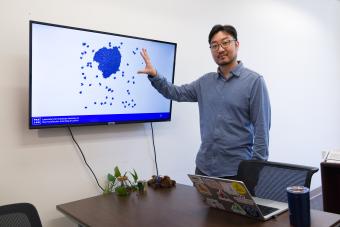
Alexander Pak, assistant professor of chemical and biological engineering, has received a National Science Foundation CAREER Award for his research on how biological systems function through the use of data-driven techniques and machine learning.
The $840,000 award covers five years of research, supporting Pak and his team’s work to better quantify path entropy, a measure of the irreversibility or thermodynamic “cost” of an observed sequence of events in time (or pathway). Pak hypothesizes that this metric may help explain how competing assembly pathways are selected in biological systems.
"The CAREER award will help in developing computational tools that will allow us to rapidly and efficiently simulate the self-assembly process of biological systems using physics-based approaches,” Pak said. “These simulations will allow us to follow these assembly processes as they unfold on biologically relevant timescales.”
Pak answers some questions about his research and how understanding self-assembly in biological systems can lead to innovation in multiple fields.
Q: What is your latest research focused on?
Alexander Pak: I'm really interested in biological systems, and in particular protein complexes. I think of these as naturally occurring biological machines that are remarkably responsive. Living systems are very complicated, so they need internal machinery to do everything that they do.
One of the fascinating things about these systems is that proteins are natural building blocks that create complex structures, and those structures carry out many functions required for life – things like forming cellular scaffolds, controlling the shape and movement of cells, or creating tiny compartments where specialized chemical reactions can occur. One common theme is that many of these biological machines are composed of proteins that naturally stick together spontaneously to form highly organized higher-order structures. Nature has repeatedly used the same types of protein building blocks to create many different molecular machines with very different function. That ability to assemble the same components into different architectures is one of the reasons biology is so adaptable.
The way these building blocks stick together is through a process called self-assembly and, as the name suggests, it relies on interactions between the proteins themselves, that's where the “self” comes from, and the assembly just means they come together to form these higher order structures. Self-assembly can proceed through many different pathways, and which pathway is followed depends on the surrounding environment, such as from changes in temperature, salt, or small signaling molecules. What I'm really interested in with this project is to determine how and why certain assembly pathways are preferred over others. In other words, what determines whether the same set of protein building blocks assemble into one structure under one set of conditions, but an entirely different structure under another? If we can uncover those rules, we can begin to predict and ultimately control how biological machines assemble.
Q: What do you find most exciting about your research?
Pak: The most exciting aspect for me is developing new theoretical frameworks that let us answer scientific questions that we haven't been able to investigate before, really pushing the boundaries of what we're able to observe, test, and explain using computational tools. We're trying to push the capabilities of what computer models are able to do. For example, we’re developing tools that allow us to simulate complex biological assembly processes as they unfold over time. The types of processes that we're interested in occur on time scales on the order of hours, if not days. To put that challenge into perspective, a molecular simulation typically reaches only about a millionth of a second. That leaves a huge gap that we’re trying to overcome. Much of my research is focused on closing that gap, so we can study these systems in ways that weren’t possible before.
Q: What is the potential impact of this work?
Pak: The project is very fundamental, but the big-picture goal is to develop computational tools that will allow us to predict and design soft materials and biomolecular materials. The biggest scientific question we’re asking is whether there is a fundamental principle that determines why complex biological and soft materials systems assemble through one pathway instead of another. If we can uncover those rules, it would give us an entirely new way of understanding and engineering self-assembly for things like building platforms for more sustainable chemical manufacturing, more efficient drug and biologics delivery, or better therapeutics.
A fundamental idea we’re trying to explore is path entropy, which is very difficult to calculate. We think it may play a central role in explaining why certain assembly pathways are favored over others. My research group and several others are converging on this idea, but each approaching it from different directions and developing new ways to quantify it. If path entropy does turn out to be one of the key metrics governing pathway selection, then we have a new engineering principle for designing and controlling self-assembly. That would represent a shift in how we think about materials design. Today, we often focus on predicting what final structure will form. Our goal is to predict and ultimately control how that structure forms instead.
Artificial intelligence has the potential to accelerate that process dramatically. With AI-driven models, we could rapidly explore millions of possible assembly pathways, identify the most promising ones, and guide the design of entirely new materials before they are ever synthesized in the lab. Ultimately, that could enable new biomolecular or soft materials with broad applications across biotechnology, medicine, sustainable manufacturing, energy storage, separations, and many other areas.
Q: How does this research agenda inform your teaching?
Pak: One of the themes I’m most excited about in my teaching is broadening access to computational sciences. Many students see computational STEM as intimidating because it combines programming, mathematics, and domain knowledge from fields like chemistry, physics, biology, and materials science. My goal is to lower that barrier and make these subjects more approachable. This CAREER Award gives me the opportunity to do that in several ways. One is by developing a pilot peer-to-peer mentoring program that helps undergraduate students build both technical skills and a supportive learning community.Another is by creating hands-on learning modules for computational molecular engineering that introduces students to the underlying concepts before they ever write code and then show how computation expands what they’re able to explore.
I'm also passionate about STEM outreach. I have been working with middle-school and high-school teachers to develop activities that incorporate data literacy, scientific reasoning, and, increasingly, how generative AI might be used thoughtfully as a tool for learning. I think AI is going to reshape STEM education over the next few years, and I want to help students and teachers use it effectively. Lastly, I'm rethinking how I teach my own courses. I’m experimenting with transitioning toward interactive Python notebooks to replace traditional lectures, which will let students play with ideas and receive immediate feedback. I plan to let students do live experimentation to actively test concepts, give them a space to try things out and make mistakes in low-stakes environments, and discover solutions for themselves.
About Mines
Colorado School of Mines is a public R1 research university focused on applied science and engineering, producing the talent, knowledge and innovations to serve industry and benefit society – all to create a more prosperous future.