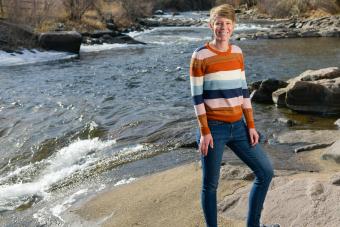
Adrienne Marshall, assistant professor of geology and geological engineering, has received a National Science Foundation CAREER Award for her research on how extreme snowpack conditions are evolving in the Western U.S.
The $737,140 award will cover Marshall’s work, which will draw on measurements from as far back as 1950 to expand the picture of how snowpack has been affected by high and low extremes over long periods of time. Using more than 70 years of data, Marshall will create a new and updated dataset that will give a comprehensive view of the snowpack’s possible past and future, informing decision makers on how to deal with potential outcomes.
“We really want to understand how snow is changing,” Marshall said. “It varies so much year to year that the longer record we can have, the better we can understand what’s happening.”
As a part of the project, Marshall will also collaborate with NatureBridge, a nonprofit that connects elementary and middle school students with environmental education. NatureBridge participants will take snow measurements in Yosemite National Park, learning how environmental science researchers collect data in the field.
Prior to graduate school, Marshall worked at NatureBridge as an environmental educator, and that experience was part of the reason she decided to pursue a career in academia as a computational hydrologist. She hopes to bridge the gap between the students’ experience at NatureBridge and the practice of science and research at universities, including hosting environmental educators at Mines, where they’ll be able to work with Marshall’s lab group and see research in action.
“Students will collect snow data in the field and then compare it to existing snow data products to see how our measurements are the same or different. This will allow them to think critically about the many reasons these observations might differ,” Marshall said. “That’s really good for science literacy overall.”
Here, Marshall answers some questions about her research and why understanding snowpack in the western U.S. matters.
Q: What do you find most exciting about your research?
Adrienne Marshall: This will be one of the first snowpack data products that goes back to 1950 or so. A lot of other products have gone back to 1980 or 1970, which is around when the satellite record started, but some of the new climate and meteorological data sets that are out there are allowing us to develop these estimates going back even further.
Another thing we'll do as we develop these estimates is to account for the uncertainty in the climate data. Often, existing snow products will have one deterministic value, and here we plan to come up with an ensemble where we'll say maybe we don't know exactly the value, but here's our range of estimates of what snow values might have looked like. Being able to characterize the uncertainty gives us more confidence about the rest of our findings.
We're also really interested in snow extremes and looking at how large of an area is covered by what we call snow drought, which means really low snow years, or snow deluge, meaning really big snow years.
If we think about this year as an example, we've had this massively widespread snow drought. It's not just Colorado, it's not just California, but most of the western U.S. has had a really bad snow year. There are a lot of ways that's more impactful than if you had an isolated snow drought, just in Colorado, for example. We rely on these interconnected water systems, we trade energy throughout the western U.S. and we use snow water for energy. So, understanding how widespread snow droughts are is going to be really important.
Another thing I think is exciting is there's been this idea of climatological whiplash in recent years, so where we go from an unusually wet year to a drought or vice versa, and we think that's also useful for understanding what the impacts look like on the ground. We'll look at snow whiplash and see how often we go from a really big snow year to a really low snow year.
Q: What is the potential impact of this work?
Marshall: This year, we have had this catastrophically bad snow drought, and as we think about how bad the impacts will be to reservoirs, a big question is what's going to happen next winter? Right now, we don't know if next winter we will have another very bad snow drought. If so, it's going to be really bad for our reservoirs. The forecasts for Lake Powell in Utah and Arizona have shown the potential for it to go below its minimum power pool threshold next winter. If we get another bad snow year, that's much more likely. If we get a good snow year, it’s much less likely that negative impact will happen. I think understanding these whiplashes can affect the impact of changing snow on our water resources, our fire risk, or how catastrophic a bad snow year will be for the recreation economy. Maybe we can handle one bad snow year, but handling multiple is different.
I'm also excited that other researchers should be able to use the snow product we’re creating for their own questions too.
On the education side, NatureBridge serves thousands of students each year. By working with the educators there, there's a ton of potential to reach middle school students and get them some exposure to snow science and really understanding where water comes from. One thing that drew me to working on snow when I was back at NatureBridge is, while working in the mountains of Yosemite, we would have snow-covered mountains, spectacular waterfalls, and that snow obviously feeds the water resources that people use for agricultural and municipal use. When I was thinking about science areas I might be interested in, something that drew me to snow is recognizing that snow accumulates in the mountains and people love it, because it's beautiful, it's fun for winter recreation, but it's also so important downstream. I find it to be a motivating scientific area for that reason, and I'm excited to think about how we can communicate that to students too, who are visiting Yosemite and then going back to their homes in the communities that use that snowmelt later in the season.
Q: How does this research agenda inform your teaching?
Marshall: I teach a surface water hydrology course where we talk about snow and its impact on water. I think there will be opportunities to build some of the outcomes of this research into how we think about snow in that class. I'm also teaching a climate change and water class as a special topic, and of course that connects really closely with the outcomes of this proposal.

About Mines
Colorado School of Mines is a public R1 research university focused on applied science and engineering, producing the talent, knowledge and innovations to serve industry and benefit society – all to create a more prosperous future.