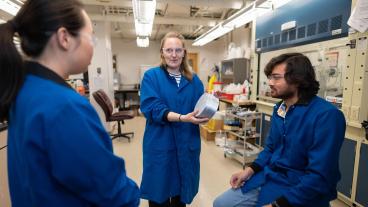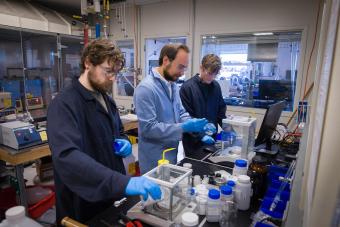
Research Assistant Professor Kamil Ciesielski, center, works in the lab with students Robert Laurie and Thomas Perkins. Laurie and Perkins are part of a VIPER research project on quantum materials discovery led by Ciesielski and Professor Eric Toberer.
Ceramics engineering student Rob Laurie knew he wanted to do undergraduate research, but at the end of his sophomore year, he was still struggling to find the right project.
A meeting with Physics Professor Eric Toberer changed all that.
When Laurie mentioned he didn’t have any plans for the summer of 2025, Toberer suggested he join the vertically integrated research project he was co-leading with Kamil Ciesielski, research assistant professor of physics, studying quantum materials. The topic overlapped well with Laurie’s background in materials science and involved learning more about nanoparticles, a type of material that could have applications across the spectrum of quantum technologies.
"Getting involved in this meant I was working on topics relating to different quantum phenomena,” Laurie said. "It feels like I’m actually doing what I came to Mines for.”
While interdisciplinary work that cuts across fields is nothing new at Mines, the research project Laurie joined is part of a novel concept intentionally involving students across disciplines and pulling together undergraduates, graduate students and faculty to work together.
VIPER – Vertically Integrated Projects for Experiential Research – currently supports eight research projects, all of which are interdisciplinary and touch on cutting-edge topics like quantum, robotics, AI, space exploration and more.
For the undergraduate students involved in VIPER, the experience is markedly different from other research opportunities. Most of those opportunities are paid research fellowships, where students work for a stipend or as part of work-study for a semester or one academic year. VIPER instead awards academic credit and projects are longer-term, with students able to engage in them over several years.
“It’s really more than just working in a laboratory,” Ciesielski said. “We want to create an environment where students join as freshmen, stay all four years and maybe even continue through if they stay at Mines for grad school, and take on more of a leadership position.”
One of the biggest differentiators with VIPER is students are part of a larger, collaborative effort crossing not just majors and disciplines, but also academic years, and often with multiple faculty members involved. At the start, undergraduates get their initial experience with research and are integrated into the team. As time goes on and they better understand the material, they can become peer mentors and advise younger students. And if they stay on the team through graduate school at Mines, they can lead aspects of the projects themselves.
“These are long-term, large-scale sustainable projects,” said Lakshmi Krishna, director of undergraduate research. “Faculty don’t have to continually train new students - when new members join, they are trained by students who have been on the project already. Students gain not just research experience, but leadership skills as well.”
Krishna co-developed VIPER with Jack Bringardner, teaching associate professor and director of education innovation in the Engineering, Design and Society Department. Bringardner is on the executive steering committee for the Vertically Integrated Projects Consortium, a worldwide alliance of more than 50 universities and colleges that supports the development, expansion and success of similar programs
“A rich ecosystem of great faculty across Mines engaged in this work already exists, and those faculty are excited to do more and grow research opportunities for students,” Bringardner said.
The Quantum Materials Discovery team that Ciesielski and Toberer lead is focused on the calculations, synthesis and characterization of materials with Kagome lattice structures. The goal is to better understand them and their quantum properties – the possibilities for new quantum materials are vast. While most of the team consists of students in physics, chemistry and materials science, Ciesielski’s team also includes young researchers majoring in other fields, like computer science.
On the project, a physics student can focus on studying the material’s properties while a computer science student might have the technical background to work on the computation of data and theory work.
“We want to make it multidisciplinary,” Ciesielski said. “We want people who are excited to work on quantum materials.”
One quantitative biosciences and engineering student on Ciesielski’s team has found her place by contributing primarily to electron microscopy work. She’s stayed on the project for more than a year now and has become a mentor on the team.
“We’ve designed the project to teach techniques with two features: one, that the learning outcomes can be applied to multiple academic fields, and two, that there is a full feedback loop, so students have their hands on all aspects of their work,” Ciesielski said. “There is a high likelihood that what a student learns here will either be directly relevant or highly transferrable to their future careers. It’s not just the research, but the idea is to make VIPER a significant contribution to the experience in college.”
As for Laurie, he’s been on the VIPER team for more than seven months and plans to stay for his entire undergraduate career at Mines. Then, as he hopes to work on a master’s degree at Mines, he’d like to stay on as a mentor and team leader. After Mines, he hopes to find a quantum research team in Europe where he can work on a PhD.
“At first, it felt like drinking from a fire hose. There was so much stuff to learn and so many different procedures. But it’s been so interesting and such a massive learning experience,” Laurie said. “I don’t entirely know what I expected, but VIPER has really solidified that this kind of research is what I want to do.”
About Mines
Colorado School of Mines is a public R1 research university focused on applied science and engineering, producing the talent, knowledge and innovations to serve industry and benefit society – all to create a more prosperous future.