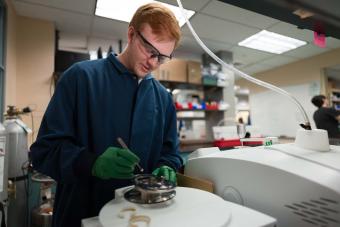
Undergraduate chemistry student Wyatt Brooks sets up an experiment in Associate Professor Michael McGuirk’s lab on campus.
On any given day at Mines, undergraduate students can be found in research labs across campus, running experiments, troubleshooting new ideas or chasing answers to complicated questions. From their first semester, many students step into research as active contributors, learning to navigate complexity and build skills that carry into their careers.
With a robust research portfolio and faculty tackling real-world challenges, Mines makes it easy for undergraduates to get involved early.
“We are an R1 institution. Research is our bread and butter,” said Lakshmi Krishna, director of the Office of Undergraduate Research. “There are a lot of opportunities to get involved in research just from how many faculty we have who are working on some exciting topics.”
The barrier to entry is intentionally low, allowing students to begin building their professional toolkit immediately. “Our undergraduate students can jump into research at any time,” Krishna added. “We have the Mines Undergraduate Research Fellowship (MURF) where a small cohort of students can do research in their very first semester on campus.”
Tony Nagygyor ’19, now a senior scientist at Procter & Gamble working on Dawn Powerwash, helped develop synthetic biology technology in Associate Professor Nanette Boyle’s lab as an undergraduate. His experience quickly reshaped his expectations of what research looks like.
“I went into undergraduate research at Mines with this expectation of things being able to progress linearly and being able to get some big insights fairly quickly,” he said. “For my first work in the lab, I quickly learned that is definitely not the case in the real world of research. There are setbacks. There are iterations. There are pivots.”
This environment forced a shift from passive learning to active, disciplined problem-solving that he now uses in his professional role. “It takes a very analytical mind to go step by step through all the things that could go wrong,” he said. “Being very methodical was a skill set I learned very quickly through that first semester experience.”
Beyond the technical skills, undergraduate research provides unique mentorship opportunities. “The idea of having close relationships with professors is one of the biggest differentiators with regards to how much you get out of it,” Nagygyor said. “It’s the opportunity to engage with a professor that may not teach undergraduate classes. You have an opportunity to interact in a one-on-one environment and in a small group and in solving problems that are far more complex than any sort of problem that you would tackle in the classroom.”
These experiences have carried into his current role, shaping how he’s able to tackle the questions and challenges that he encounters every day.
“The whole story shapes together pretty succinctly in regard to where I’m at as a professional now,” he said. “I’ve been doing research of a variety of different forms. There’s not one specific knowledge set but continuing to apply similar principles. All those foundational skills continue to carry all the way through.”
For Tomi Olusoji ’24, undergraduate research helped clarify her career trajectory. Working in Associate Professor Melissa Krebs’ lab on biomaterials for drug delivery and tissue engineering applications, experiences that once felt “mystical” and confined to movies became a tangible passion.
“When I actually started working in the lab, I felt at home. I felt like this is what we meant to do. I was very passionate about it,” Olusoji said. “There’s actually way more that we don’t know than we do know. That prospect was exciting, because it felt like I could help find something and add one sentence to a textbook.”
The laboratory experience she gained as an undergraduate allowed her to jump right into the next stage of her career. She’s now pursuing a PhD at the University of Colorado Anschutz, studying cancer biology.
“I feel so lucky because I started by PhD right out of undergrad,” she said. “After graduating, a lot of people need one or two years of experience before they can apply to a PhD program. But by the time I graduated, I had two years of research experience, plus summer internships. All of that together really set me up for success.”
Even in a new field, the skills she built at Mines continue to carry forward. “There’s nothing that they can throw at me now that’s really scary. Even though my research at Mines was related to health, I’m now in a cancer biology program that’s very different, subject-wise. But a lot of those skills I learned are the same and transfer over.”
Undergraduate research at Mines is a launchpad for what comes next. Students leave campus with the ability to ask better questions, navigate uncertainty and contribute meaningfully to the workforce from day one.
Learn more and support Mines’ undergraduate research programs at undergraduateresearch.mines.edu.

About Mines
Colorado School of Mines is a public R1 research university focused on applied science and engineering, producing the talent, knowledge and innovations to serve industry and benefit society – all to create a more prosperous future.