More than 6,000 years after its invention, a team of Colorado School of Mines students is working to improve on one of humanity’s most important pieces of technology – the wheel. But the design they created won’t be for Earth-based purposes.
The lightweight, flexible, long service-life wheel and tire they’re designing needs to be able to skillfully traverse the rugged surface of the Moon, and NASA is taking notice of their novel approach in designing a rover wheel for next-generation lunar mobility.
The team has been named a finalist in the Rock and Roll with NASA Challenge, one of 10 teams to move on to Phase 2 of the competition, emerging as a finalist from an initial field of 93 teams.
“The team is mostly undergraduate students and they’re coming up with engineering methods on their own that you typically learn as maybe a senior or even on the job at a space facility,” said Frankie Zhu, assistant professor of mechanical engineering, who is advising the team. “They’re just an amazing group.”
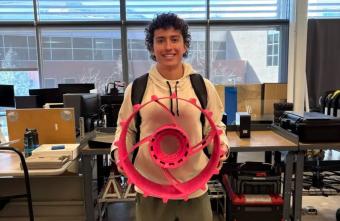
The team’s design is a 3D-printed wheel made of space-rated plastic. The wheel features deformable spiral spokes able to absorb large impacts and durable enough to withstand traversing the surface of the Moon. For Phase 1, the team created the prototype design and have now moved on to creating a full prototype, using 3D printers to create the wheels and testing the materials used to ensure they stand up to the harsh environment on the Moon.
"I value being able to work on a team for this project because it’s not like an assignment for class. It’s closer to the real-world experience of what an actual engineering project would look like,” said team co-captain Waylon Weeks, a sophomore in mechanical engineering. “A lot of us on the team haven’t done this kind of work before, so we have to work together to figure it out.”
Weeks also credits their advisor and resources at Mines for their success. "None of this would have been possible without support from Frankie [Zhu] and the RoSE [Robotic Space Exploration] lab."
Several aspects of the team’s design show how they worked together to use design thinking in creating wheels that can be both effective and thoughtfully constructed. The team 3D printed the wheel in four parts that dovetail to fit together without needing a bonding agent. In preliminary tests, the wheels have proven to be structurally sound.
The next phase of testing will include mounting the wheels to a rover created by a team from Mines’ Space Resources Program and trying them out in the Mines lunar test bed. If the team advances to Phase 3, they’ll get an invitation to the Johnson Space Center in Houston to mount their wheels on the MicroChariot, a test rover for lunar surface operations.
Team members said while challenging, the process of re-inventing the wheel for a lunar rover has been a great way to flex their creative thinking and engineering skills.
“We can create our own requirements of what makes the most sense, plus we do all the material testing and make our own little path of how we create this final product,” said team member Cameron Cox. “It’s the process of getting to that end goal and creating and developing so we find the best way to get there and improve as engineers at the same time.”

About Mines
Colorado School of Mines is a public R1 research university focused on applied science and engineering, producing the talent, knowledge and innovations to serve industry and benefit society – all to create a more prosperous future.