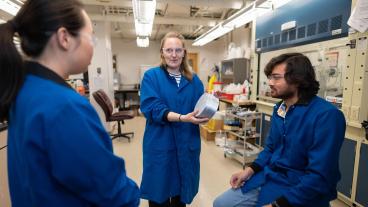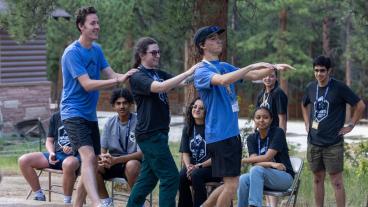
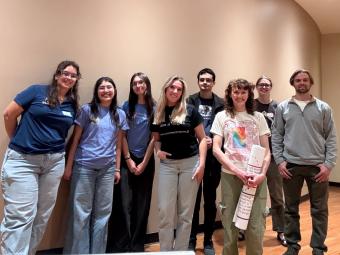
More than 130 middle and high schoolers from Denver area schools visited Colorado School of Mines earlier this spring for a hands-on experience combining math and computer programming. By the end of Math@Mines, students walked away with code they created to draw pictures or test strategies on decision-based games all while building connections with Mines faculty, students and their own peers.
Hosted by the Mines Mathematics and Computing Collaborative (MMCC), Math@Mines was led by a mix of Mines undergraduate and graduate students, with support from the Applied Mathematics and Statistics Department and the Graduate Student Government. In attendance were middle and high school students from at least 14 schools across Denver, including Morey Middle School, DSST Cedar High School, Denver Language School and Robert F. Smith High School.
“It’s always important to provide avenues where students can be exposed to math in a fun way that emphasizes problem-solving done in groups," said Amanda Castillo-Lopez, one of the Mines volunteers. "For me, being able to work on hard problems with peers is what makes math so enticing. Math is boundless in its application and getting nonlinear exposure to topics at Math@Mines really opens the math world to students."
Over the past two semesters, more than 15 MMCC members developed workshops, promoted the event and worked to make the day as impactful as possible. The leadership of MMCC worked closely with administration and faculty at the Denver schools to ensure all students in attendance would be able to participate, regardless of their primary language, age or level of mathematics.
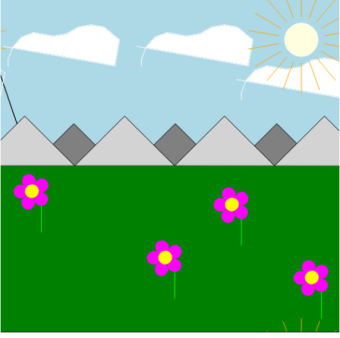
The day began with a coding workshop based on the website Turtle Academy. Turtle Academy allows students to draw pictures using programming instructions to move a small turtle across a canvas, leaving colored lines just like a pen. Using this visual medium, students were taught the basics of programming concepts such as functions and loops, all while applying their creativity to create unique, colorful drawings.
From there, students worked in groups to brainstorm, delegate sub-roles, and create a landscape drawing of their own design as part of a friendly competition. Students created everything from cheesy Dorito landscapes to black holes, with a few groups tackling fractal designs.
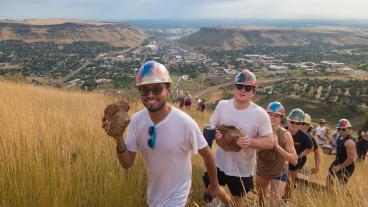
After the first workshop, students were led on a campus tour by MMCC members and Mines tour guides. Students also had the opportunity to check out an informal poster session, where their peers presented solutions to applied math problems that were sent to participating schools months in advance.
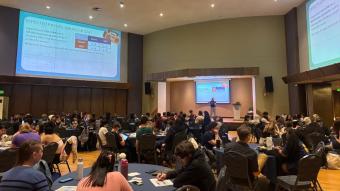
The day ended with a workshop on game theory, where students learned how common games like rock-paper-scissors are described mathematically and how effective strategies can be determined through use of logic and probability. Students formed groups and developed strategies for the game Hawk-Dove, in which different animals challenge each other for resources.
After having time to test their strategies, groups competed in a bracket-style tournament as a way of applying their new knowledge about game theory. The final four games were projected with the whole room so students could see which strategies were the best, and the winners got to take home prizes.
“Math@Mines was a special day for all those in attendance, and MMCC looks forward to hosting the event again next year,” said organizer Rachel Bertaud, a PhD student in applied mathematics and statistics. “The amount of excitement shared by both Denver and Mines students to support one another, learn and grow as a community was inspiring. Math@Mines showcased the talent of Denver students and their willingness to grow – their contributions to this world are sure to be amazing.”
MMCC would like to thank Professors Stephen Pankavich, Samy Wu Fung, Luis Tenorio and Terry Bridgman for providing the applied math word problems and all of the other Math@Mines volunteers including Mia Murphy, Amanda Castillo-Lopez, Troy Sorensen, Kate Harvey, Madison Lytle, Daniel Ramirez, Andres Pruet, Nathan Hoehndorf, Sophia Harper, Victoria Filio, Ryker Fish, Amelia Manley, Anna George, Joseph Brownlee, Reese Burke, Ally Gray, Eric Gelphman, Brendan McKinley, Lauren Quesada, Andrew Holmberg and Professor John Griesmer.
Anyone interested in attending, volunteering or supporting next year's event are encouraged to reach out to Rachel Bertaud at rachel_bertaud@mines.edu.
About Mines
Colorado School of Mines is a public R1 research university focused on applied science and engineering, producing the talent, knowledge and innovations to serve industry and benefit society – all to create a more prosperous future.