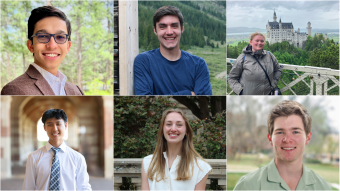
A record 13 current Mines students and recent graduates have been awarded a 2026 NSF Graduate Research Fellowship.
The prestigious program, which began in 1952, is the oldest continuous graduate fellowship of its kind. It provides three years of support for the graduate education of individuals who have demonstrated potential for significant achievements in the STEM disciplines.
The Mines awardees include six students who are pursuing their PhD at Mines or graduated with their Bachelor of Science in May:
Abigail Broscius: Improving proactive power shutoffs
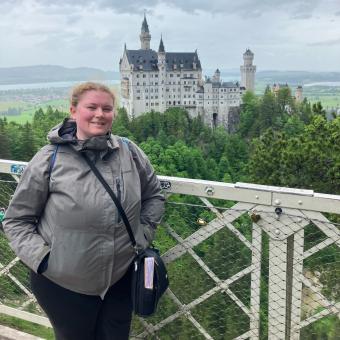
Abigail Broscius, a PhD student in electrical engineering, is working with Qiuhua Huang, associate professor of electrical engineering.
Her research is focused on making Public Safety Power Shutoff (PSPS) events more effective at preventing wildfires while also reducing their impact on communities. PSPS events are a risk reduction strategy used by electric utilities in places like Colorado and California to proactively shut off power to an area near active wildfires or during extreme or critical wildfire risk conditions.
Olivia Hunsberger: Fundamentals of nuclear fuel reprocessing
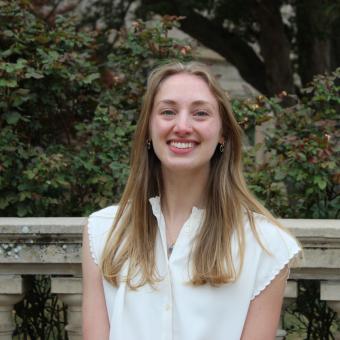
Olivia Hunsberger, a PhD student in nuclear science and engineering, is conducting research on lanthanide and actinide separations chemistry with Mark Jensen, Jerry and Tina Grandey University Chair in Nuclear Science and Engineering.
“My work will focus on developing a better understanding of rare earth element extraction from used nuclear fuel,” Hunsberger said. “My goal is to improve the fundamental understanding of the methods used to reprocess (reuse) used nuclear fuel.”
Kylan Jin: Treating “forever chemicals”
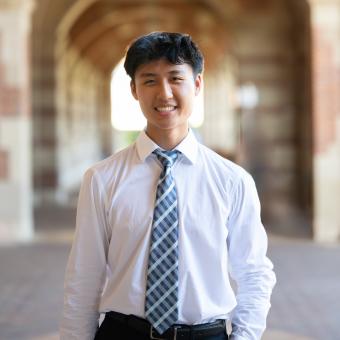
Kylan Jin, a PhD student in civil and environmental engineering, is working with Timothy Strathmann, professor of civil and environmental engineering.
“My research explores how to develop a treatment system that uses UV (ultraviolet) light to break down extremely tough contaminants called PFAS or better known as 'forever chemicals,' " Jin said. "These chemicals are often found in nonstick cookware, food packaging, and firefighting foam.”
Luke Wanner: Building ultra-sensitive quantum sensors
Luke Wanner, who graduated in May with a bachelor’s degree in engineering physics, will start his master’s thesis in quantum hardware engineering in the fall, after which he hopes to pursue a PhD. At Mines, his advisor is Wouter Van De Pontseele, assistant professor of physics.
“My research focuses on building ultra-sensitive quantum sensors to detect some of the universe's most elusive particles — neutrinos — as they scatter off atoms. To capture these incredibly faint interactions, I work on optimizing specialized superconducting devices, specifically linking Transition-Edge Sensors with microwave SQUID multiplexers, to achieve extreme precision," Wanner said.
“Because these delicate quantum components are easily disrupted by everyday background radiation from space, part of my project involves setting them up deep underground at the CURIE lab inside the Edgar Experimental Mine. By fine-tuning how these sensors operate together and testing them in a fully shielded environment, my work not only drives fundamental physics discoveries but also advances the vital hardware used in future quantum computers.”
Omar Mansurov: Computational materials development
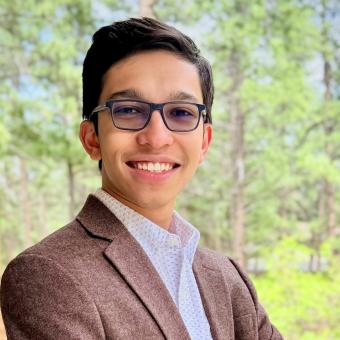
Omar Mansurov, who graduated in May with a bachelor’s degree in chemical engineering, will pursue his graduate studies in chemical and biological engineering at Northwestern University.
“Modern chemical technologies, and especially those focused on chemical reactions or separation like plastic fabrication, fertilizer production and water purification rely almost entirely on push-and-pull interactions between atoms, which are the microscopic building blocks of all physical matter. My research focuses on rapid prediction of these atom-atom interactions using machine learning and other up-and-coming computational technologies," Mansurov said.
“If we can reliably, accurately and quickly predict atom-atom interactions using computer simulation, we can develop chemical innovations at a much quicker pace. Examples of these developments include custom materials synthesis, targeted drug development, and futuristic energy storage/generation," he said. "Specifically, I aim to direct my research towards materials development for carbon dioxide capture, forever chemical (PFAS) environmental extraction, and chemical catalysis.”
Ryan McGinnis: Ultra-high temperature ceramics
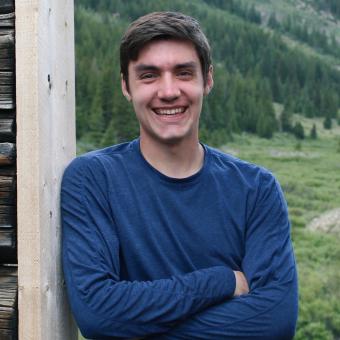
Ryan McGinnis, who graduated in December with a bachelor’s degree in metallurgical and materials engineering, is pursuing a PhD at the University of California, Berkeley.
His focus is ultra-high temperature (+2500C) ceramics. He aspires to combine his expertise in mechanics, high temp crystallography and characterization methods to become faculty leading efforts on ceramics for energy and space applications.
In addition, seven Mines undergraduate alumni received an NSF GRF to support their graduate studies at their current institution:
- Amit Sela ‘24 Vanderbilt University
- James Crea ‘25, University of Illinois
- Duncan Byrne ‘24, University of Colorado Boulder
- Levi Grenier ‘23, Massachusetts Institute of Technology
- Dominic Piccone '25, Johns Hopkins University
- Emma Khorunzhy '25, California Institute of Technology
- Jack Dorsey '25, Northwestern University.
Applications to the National Science Foundation Graduate Research Fellowship are supported at Colorado School of Mines through the Office of Nationally Competitive Scholarships. For more information about applying for the National Science Foundation Graduate Research Fellowship or other national and international scholarships, please contact Ashley.weibel@mines.edu and visit nationalscholarships.mines.edu.

About Mines
Colorado School of Mines is a public R1 research university focused on applied science and engineering, producing the talent, knowledge and innovations to serve industry and benefit society – all to create a more prosperous future.