Climate change is not only altering how much water flows through rivers, but also when that water is available, according to a new study published today in Nature Water.
The issue of when the water is flowing from snow fields to rivers is an often-overlooked variable that has significant implications for water users across the United States.
“Water demand varies seasonally, but until now we haven’t fully understood how climate-driven changes in streamflow distribution within the year interact with water rights and their daily administration,” said lead author Steven M. Smith, associate professor and associate department head of economics and business at Colorado School of Mines.
The study, “Narrowing streamflow distribution can alter water allocation timing and quantity,” is an interdisciplinary effort by Smith and Adrienne Marshall, assistant professor of geology and geological engineering. Both are faculty affiliates of the Hydrologic Science and Engineering Program at Mines.
While previous research has tended to focus on changes in total streamflow and the timing of peak runoff, the new study examines how streamflow is distributed throughout the entire water year. That distribution, Mines researchers say, plays a critical role in determining who can access water.
"When the same amount of annual streamflow is concentrated into a shorter period due to higher temperatures, senior water rights holders—those with the earliest claims—may capture less water than when flows are spread more evenly across the year,” Marshall said.
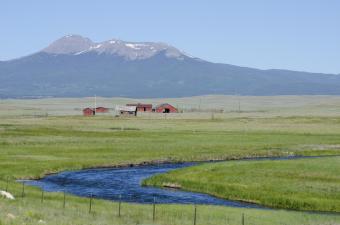
The researchers demonstrated this effect both theoretically and through analysis in the headwaters of the Rio Grande basin.
In the Intermountain West, the findings reveal an added complication: years with lower total water availability also tend to have more evenly distributed flows. This combination is likely to intensify drought impacts on junior water users, who receive water only after senior rights are fulfilled.
The researchers caution against oversimplifying the equity implications of their study. Senior water rights holders are not always socio-economically advantaged, and those senior rights are often tied to smaller allocations. As a result, changes in water availability do not map neatly onto broader measures of social or economic equity.
The study also highlights regional differences in how streamflow distribution is responding to a warming climate. In the Upper Midwest and New England, streamflow has already become more evenly spread throughout the year due to climate change. In contrast, patterns in the western United States are more complex, the researchers note.
In snow-dominated regions of the U.S. West, warmer years tend to produce a wider distribution of streamflow across the year—conditions that may benefit senior water users while disadvantaging junior users. In non-snowy parts of the region, the opposite pattern emerges: warmer years are associated with more concentrated flows, potentially offering a relative advantage to junior water users.
These findings underscore the importance of considering not just how much water is available in a changing climate, but how it is distributed over time. The issue of how those shifts intersect with long-standing water management systems is also important to consider.
"As water scarcity intensifies across many parts of the country, we hope our findings provide new insight for policymakers, water managers and communities working to adapt to a more variable and uncertain future," Smith said.
Read the full paper, “Narrowing streamflow distribution can alter water allocation timing and quantity,” at https://www.nature.com/articles/s44221-026-00639-4.

About Mines
Colorado School of Mines is a public R1 research university focused on applied science and engineering, producing the talent, knowledge and innovations to serve industry and benefit society – all to create a more prosperous future.