A Colorado School of Mines researcher is part of an international team that has set up a remote camp on the ice in Antarctica to attempt to drill for mud and rocks holding critical insights about the fate of the West Antarctic Ice Sheet in our warming world.
Ryan Venturelli, assistant professor of geology and geological engineering, is a member of the science team for the SWAIS2C (Sensitivity of the West Antarctic Ice Sheet to 2°C) project, a collaboration between 10 countries (New Zealand, the United States, Germany, Australia, Italy, Japan, Spain, Republic of Korea, the Netherlands, and the United Kingdom) involving more than 120 scientists.
An ‘on-ice’ team of 29 scientists, drillers, engineers and Antarctic field specialists including Venturelli have embarked on the project’s third attempt to drill for a 200-meter sediment core – a series of cylindrical samples of mud and rocks – from the bedrock deep beneath 500 m of ice at the Crary Ice Rise on the Ross Ice Shelf. Their on-ice camp is located 700 kilometers from the nearest Antarctic base, New Zealand’s Scott Base.
“The geochemistry of the sediments we retrieve from beneath Crary Ice Rise will enable us to build a long-data perspective of the Ross Ice Shelf and West Antarctic Ice Sheet beyond our observational records,” Venturelli said. “I’m thrilled for the opportunity to contribute to this project as a field team member.”
The vast West Antarctic Ice Sheet holds enough ice to raise global sea level by 4-5 meters if it melts completely. It is protected on one side by the Ross Ice Shelf, the world’s largest floating ice mass, which serves as a buttress slowing the flow of glaciers and ice streams towards the sea.
As our climate warms, the Ross Ice Shelf is becoming increasingly vulnerable, but there is uncertainty around what global temperature increase will trigger unsustainable melting of the shelf, and the subsequent loss of the West Antarctic Ice Sheet.
Retrieving a geological record to provide direct evidence of past temperature tipping points is the challenge driving the on-ice team’s work. Along with a relatively recent geological record, the core is expected to contain layers of sediment laid down within the past 23 million years, containing periods in Earth’s history when temperatures were warmer than they are today.
They’ll search for tiny microfossils of marine algae in the sediment, organisms that need light to survive. Their presence suggests open ocean conditions and the retreat of the Ross Ice Shelf.
“We’ll analyse the samples to collect environmental data about how the Ross Ice Shelf responded in these past times of warmth. This record from the past will help us build a much clearer picture of what temperature will trigger the retreat of the West Antarctic Ice Sheet and significant sea-level rise,” says Molly Patterson, SWAIS2C Co-Chief Scientist from Binghamton University.
No one has ever successfully obtained such a deep sediment core so far from a base and so close to the centre of the West Antarctic Ice Sheet. SWAIS2C has spent the past two Antarctic summers attempting to drill at KIS3, a site around 260km from Crary Ice Rise, but both attempts were thwarted by technical issues with the custom-designed drilling system.
Crary Ice Rise is a ‘pinning-point’ for the Ross Ice Shelf, a place where the seabed below the floating ice shelf is elevated and meets the base of the ice, anchoring the ice shelf and resisting the flow of the ice away from the continent. The researchers will analyse the sediment to learn more about the recent history of the ice rise and the role it plays in stabilising the ice shelf. There are indications that the ice at this site last grounded 1100 years ago.
“This is Antarctic frontier science, and what we’re trying to do is complex and hugely challenging, from an engineering and logistical perspective as well as being world-leading science. We’ve made great progress towards our goal over the first two seasons and have modified the drilling system for success this year,” says Huw Horgan, SWAIS2C Co-Chief Scientist from Te Herenga Waka – Victoria University of Wellington, New Zealand and ETH Zurich in Switzerland.
An extreme polar road trip followed by eight weeks living in tents on the snow
Drilling in the deep field so far from the nearest base requires a large amount of equipment, both for the drilling itself and the operations of the camp, which must be set-up from scratch.
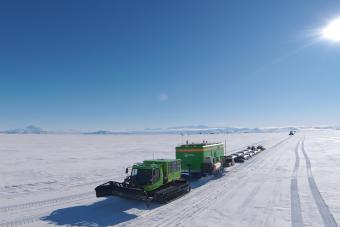
The six-member Antarctica New Zealand traverse crew departed New Zealand’s Scott Base on November 8 – operating a convoy of PistenBully polar vehicles towing the load of fuel, science and drilling equipment, and supplies to sustain the camp for the approximately 8-week season. Their 1100-kilometer journey over the Ross Ice Shelf required the use of a Ground Penetrating Radar to help them detect and avoid treacherous crevasses.
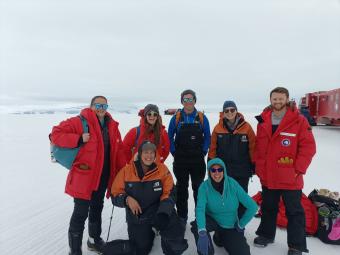
Arriving at Crary Ice Rise, the traverse team created a ‘skiway’ on the ice for ski-equipped aircraft, allowing the drillers and scientists to fly in (700 km ‘as the crow flies’). The team will live in tents on the snow, and work in shifts around the clock to make the most of the limited time at this hard-to-reach location.
On ice, Venturelli will be taking samples from sub-ice cores for microbiology and porewater geochemistry. This work will help the SWAIS2C team assess what microbial communities live beneath the ice today and during the past, and how those communities contribute to biogeochemical cycling.
In addition to her on-ice role, Venturelli is particularly interested in using sediments the team recovers to learn more about the last few thousand years of ice history. To read more about her group’s work on this topic, check out the Rates and Dates Laboratory.

About Mines
Colorado School of Mines is a public R1 research university focused on applied science and engineering, producing the talent, knowledge and innovations to serve industry and benefit society – all to create a more prosperous future.