What can the distant past – some 66 to 48 million years ago – tell us about future rainfall?
A new study led by researchers at Colorado School of Mines reveals how Earth’s water cycle responded during one of the warmest periods in its history, using clues left in the geological record to better understand how rainfall behaves when the planet gets very hot.
The results, published last month in the journal Nature Geoscience, challenge the commonly held view that wet places get wetter when the climate warms and drier places become drier.

“Understanding how rainfall behaves under a warming climate is an area of major uncertainty in future climate projections,” said Piret Plink-Bjorklund, professor of geology and geological engineering and co-author of the paper.
To conduct the interdisciplinary study, Plink-Bjorklund and lead author Jake Slawson PhD ‘25 teamed up with atmospheric science researchers at the University of Utah. The Mines sedimentologists analyzed proxy data from the fossil record – things like plant fossils, soil chemistry and river deposits – for clues on when rain fell and how often, while co-authors Thomas Reichler, professor of atmospheric sciences at Utah, and graduate student Daniel Baldassare conducted the climate modeling.
The geologic record has a lot to say about the climate at the time, Plink-Bjorklund said. Plant fossils can be compared to their nearest living relatives and the climate conditions where they grow today. Soil chemistry is sensitive to moisture and temperature – different processes occur at different conditions and result in different types of soils with distinct chemical signatures.
“Looking at the river deposits to inform about rainfall is new and in large part developed by my research group,” Plink-Bjorklund said. “We can distinguish deposits of flash floods from deposits of more moderate floods, and this gives us a measure of rainfall intensity.”
From this geologic evidence, researchers found that rainfall appears to be much less regular under extreme warming, often occurring in intense downpours separated by prolonged dry spells. Polar regions were wet, even monsoonal, while many mid-latitude and continental interiors became drier overall.
The Paleogene Period, 66 to 48 million years ago, is considered a possible analogue for worst case climate change scenarios. The period began with the sudden demise of the dinosaurs and saw the rise of mammals in terrestrial ecosystems. It was also a period of intense warming culminating in the well-studied event called the Paleocene-Eocene Thermal Maximum, or PETM, when levels of heat were 18 degrees Celsius (32 degrees Fahrenheit) warmer than they were just before humans began releasing greenhouse gas emissions into the atmosphere.
“Extreme global warmth can fundamentally reorganize rainfall patterns, producing desert-like conditions at mid-latitudes while polar regions experience high rainfall,” Plink-Bjorklund said. “Importantly, this aridity was driven not by lower average rainfall, but by shorter wet seasons and longer gaps between rain events, demonstrating that accurate predictions of future climate risk depend on understanding rainfall variability and extremes, not just annual averages.”
Read the full paper, “More intermittent mid-latitude precipitation accompanied extreme early Palaeogene warmth,” in Nature Geoscience. Funding for the research was provided by the National Science Foundation.
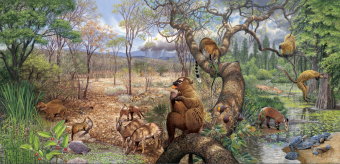
Image credit: A detail from “The Trek through Time,” a 16-plaque diorama at the U.S. Geological Survey’s headquarters in Reston, Virginia. Painted by Aldo Chiappe and courtesy of National Geographic, the scene depicts the Paleocene Epoch, 66 to 56 million years ago.

About Mines
Colorado School of Mines is a public R1 research university focused on applied science and engineering, producing the talent, knowledge and innovations to serve industry and benefit society – all to create a more prosperous future.