By Sarah Kuta, Special to Mines Magazine
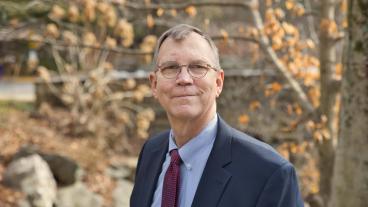
David Scriven ’70 never set out to be an entrepreneur. But with a knack for turning challenges into opportunities, it’s no surprise he ended up becoming one.
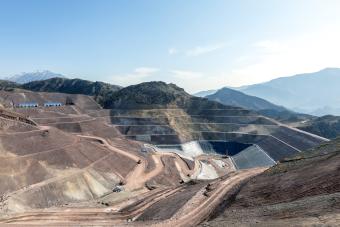
Today, Scriven is channeling his innovative spirit into his role as co-founder and chief executive officer of IronTech Resources. The Minnesota-based company uses Scriven’s patented process to extract minerals from mine tailings, transforming waste into a valuable resource while also reducing environmental impact and restoring natural landscapes.
Scriven originally developed the technique to recover uranium, but he has since applied it successfully to iron ore. Looking ahead, the company hopes to expand the technology even further to recover other high-value minerals around the world, including gold, lithium, copper, phosphate and rare earth metals.
“We can liberate minerals from just about any kind of rock,” he said. “We see a big future in our technology, especially with a lot of the critical minerals.”
During his decades as an engineering consultant, Scriven has used his diverse background and deep knowledge base to guide clients toward creative solutions, often helping them save time and money in the process.
It was his work with uranium mining clients in Wyoming decades ago that initially planted the seed for his proprietary mineral recovery process, which he calls “dynamic hydro liberation.” Over the course of several projects, he identified a broader mining industry challenge—how to affordably, efficiently and sustainably extract valuable materials from already mined ore—and realized he might be able to help overcome it.
“I was driving down the highway and thinking to myself about how uranium deposits are formed,” he said. “I was thinking about how, when uranium precipitates out [of groundwater] on sandstone, it doesn’t penetrate the sand grains. It’s a coating. If we could knock that coating off the sandstone, we could screen it out and extract it.”
After years of experimentation, fine tuning and collaboration, Scriven is bringing his idea to life with IronTech Resources. With his technique, tailings—or the materials that are left over from mining—are combined with water to form a slurry. The substance is then pumped through specialized nozzles into the chambers of a machine that’s about the size of a Ford F-150 truck. Inside, high-velocity water breaks the particles apart, producing a high-grade concentration of the target mineral.
In trials with iron ore tailings in northern Minnesota, for instance, this technique produced a premium, 65 percent iron concentrate, according to the company. IronTech Resources’ machines can process roughly 50 tons of slurry per hour, meaning users will be able to quickly convert legacy tailings into profit.
According to Scriven, the technique uses much less energy than the typical mineral recovery process, which involves crushing and grinding ore using a ball mill.
“It’s a two-step process, but all we use is water,” said Scriven. “We have a couple of different ways of adding energy into the particles to make the particles break along the mineral boundaries. It’s very, very efficient.”
The company is still in the early stages of commercializing the technology and is currently building a demonstration plant near Biwabik, Minnesota. They plan to scale up the business from there.
Scriven and his IronTech Resources colleagues believe their technology could be instrumental in the push to boost the domestic production of critical minerals— those that the United States’ government has deemed essential to the nation’s economy or security and at high risk of supply chain disruption. Supporting critical minerals production is also an effort many researchers are working on at Mines. Recent research led by Mines’ Elizabeth Holley suggests one promising path forward is to extract critical minerals from already mined ore, a finding that reaffirmed Scriven’s mission and vision at IronTech Resources.
“My whole philosophy is: How can we take this waste and make it valuable?” said Scriven. “What can we do with this waste and how can we make this work? That’s the attitude we have to take in the U.S. going forward.”
Scriven originally entered Mines on a football scholarship, but he was also fascinated by the idea of becoming an engineer, he said. Even now, more than 50 years after graduating, Scriven still sees clear echoes of his time at Mines in his professional
success today.
“All ideas are iterative,” he said. “You don’t just get the lightbulb. It comes from years of experience and knowledge, until all of the pieces line up together. But the pieces have to be there first.”

About Mines
Colorado School of Mines is a public R1 research university focused on applied science and engineering, producing the talent, knowledge and innovations to serve industry and benefit society – all to create a more prosperous future.