By Jenn Fields, Special to Mines Magazine
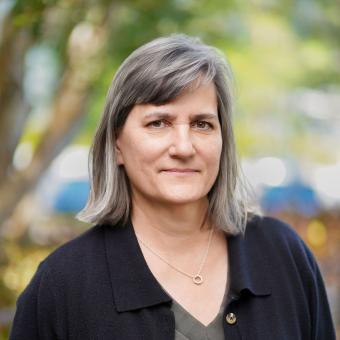
At every important step in her career as a physicist, Cathy Mader ’87, MS ’89 jumped at an unexpected opportunity. As an undergraduate at Mines, a professor opened the door to graduate studies, which she hadn’t considered as a possible pathway for herself. Upon completion of her PhD at Michigan State University, Mader applied to a physics faculty job outside of the usual hiring cycle at Hope College, which became her professional home for 30 years. When a position opened on the Experimental Physics Investigators (EPI) Initiative at the Gordon and Betty Moore Foundation, Mader jumped one more time.
Now, she supports opportunities for other scientists, overseeing grants that let physics researchers explore bold ideas that would be challenging to pursue without long-term support or access to the initiative’s collaborative community. In addition to funding, the EPI brings grant recipients together annually to create cross-pollination of ideas across fields.
“Physicists don’t work in a bubble,” said Mader, now working as a program officer for the EPI. “It’s really rewarding to see people from different subfields go off to work on projects together because they’ve found a creative way to tackle a problem.”
Mader herself hasn’t worked in a bubble. Going all the way back to her education at Mines, mentors and collaborators in the scientific community played a vital role in her success. She arrived at Mines as an undergraduate with no previous knowledge of higher education. As a first-generation college student, she often felt she was missing “insider” info. Near the end of her senior year at Mines, she was studying in the physics building when F. Edward Cecil (now an emeritus professor of physics) asked everyone what they were doing after graduation.
“I said, ‘I don’t know, I am probably going to work in the factory with my dad again this summer,’” Mader said. “He said, ‘No, you need to go to school.’ If it weren’t for Ed Cecil, I wouldn’t have gone to grad school.”
Cecil was one of many people who helped her navigate academia, and she has spent her own career paying that forward.
“There were so many things I didn’t know being a first-generation American and first-generation college student that other people thought were normal,” she said. “So then, as a faculty member, you spend time making sure everyone gets that information before it’s too late.”
Her role at the Moore Foundation is the next step in this work supporting up-and-coming physicists. The foundation takes a strategic approach to science philanthropy, tracking the pulse of the physics community and seeking out gaps in support. They offer grants in important corners of physics that aren’t well funded elsewhere, such as emergent phenomenon in quantum systems. “That’s a place where our investment in material synthesis and quantum materials has made a huge difference, because it’s not an area that’s usually funded by federal sources,” she said.
The Moore Foundation also noticed that while early-career researchers had abundant funding opportunities, less was earmarked for mid-career investigators. EPI developed a grant to fund these researchers over five years—a stretch beyond the typical three-year federal research grant that gives investigators more freedom.
Mines physics professor Kyle Leach, whose research uses radioactive isotopes in superconducting quantum sensors to explore fundamental questions about subatomic physics, is part of the inaugural cohort of recipients of EPI’s grant for mid-career researchers, and Mader oversees his grant. “They’re all supporting students and post-docs, and being mid-career, these researchers can take on leadership roles, too,” Mader said. “So not only is Kyle doing amazing research, he’s also able to connect people. It’s helping advance the field as a whole.”
Supporting researchers like Leach is only one facet of Mader’s role. She is equally passionate about spreading the word about all the possibilities a physics degree can offer—possibilities that help advance knowledge and the future of physics.
“You don’t have to become the investigator leading a lab research team. There are a lot of other ways you can be contributing to research,” she said. “You can be involved in the private philanthropy sector or at the federal level, and your knowledge can still contribute to science.”
About Mines
Colorado School of Mines is a public R1 research university focused on applied science and engineering, producing the talent, knowledge and innovations to serve industry and benefit society – all to create a more prosperous future.