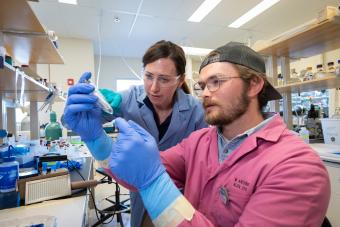
Professor and Ben L. Fryrear Presidential Chair Jenifer Shafer works with graduate student Klemmer Nicodemus in one of the nuclear engineering labs on campus.
By Jenn Fields, Special to Mines Research
Across the American energy sector, the demand for more power on the grid is creating the need for an expanded portfolio of energy resources that are secure, affordable and reliable. The United States is working to diversify its energy portfolio and strengthen energy security to meet that demand, and federal research priorities are focused on maturing technologies that access homegrown energy resources, create jobs and rely on American-made supply chains.
As the U.S. pursues greater energy independence and abundance, Colorado School of Mines researchers are leading the way in delivering practical, scalable solutions in energy technologies. Leveraging the university’s deep expertise in advanced materials, systems integration and subsurface science, Mines researchers are developing next-generation fuels, cleaner nuclear energy technologies and scalable solutions in geothermal energy.
Geothermal unlocks ‘free BTUs’
Geothermal energy has the potential to power many locales in the U.S. California is home to the oldest geothermal power plant in the country. New York City uses geothermal heating in large commercial and residential buildings. The current push for new technologies is being tested in western states, where geothermal resources are abundant.
“There’s a lot of potential if you can drive the cost down,” said Will Fleckenstein, a former petroleum engineering professor and department head who now serves as the director of strategic business development in Mines’ Office of Global Initiatives and Business Development. “There are places around the world where there’s huge opportunity to get these free BTUs.”
The Great Basin is one of them. A recent U.S. Geological Survey study suggested potential to generate up to 135 megawatts of electricity via geothermal there—up to 10 percent of the country’s current power production capacity.
However, generating affordable geothermal power at scale in the U.S. requires a different engineering approach. In many places, such as Hawaii, there’s plenty of subsurface heat but no natural reservoirs for 24/7 electricity generation. In these types of locales, engineers can use enhanced geothermal systems, or EGS, to create underground reservoirs using horizontal drilling and fracturing techniques borrowed from the oil and gas industry.
Mines faculty with expertise in oil and gas completion have been in demand to help tap this resource, said Jennifer Miskimins, F.H. Mick Merelli/Coterra Energy Distinguished Department Head Chair of Petroleum Engineering.
“A lot of what I’ve worked on in oil and gas is being extrapolated to geothermal,” Miskimins said. “These are techniques that we started developing in the early 2000s, when the shale revolution began. Those are relatively mature technologies now, and geothermal is where unconventional reservoirs were in the early 2000s. The early days. But that’s the nice thing about geothermal: We have a lot of learnings that can be extrapolated, and we can get up that curve quicker.”
The techniques transfer, but geothermal still presents unique challenges: higher temperatures, larger bore holes and more failure potential from larger fluid volumes. Mines’ deep expertise in subsurface systems is making researchers key players in this space, though.
Fleckenstein developed a patented process using sleeves that operate as a subsurface heat exchanger to better control fluid flow and avoid a common short-circuiting issue. The sleeves are being patented through Mines, and his company GTO Technologies is now developing advanced geothermal, solution mining and geological hydrogen solutions for commercial operations, including a high-temperature tractor to scout wells underground.
“We’ve got all the expertise,” Miskimins said. “We’ve got the drillers, the completion people, the reservoir people who are managing the heat transfer, the economists—Mines is uniquely positioned to help make enhanced geothermal economically viable.”
Nuclear energy: reuse and recycle
Nuclear energy has seen renewed interest in recent years. Its potential for providing zero-carbon baseload electricity prompted the Biden administration to lay out a roadmap to tripling nuclear power generation in the U.S. Now, the Trump administration is prioritizing nuclear for its potential to provide always-available, abundant, affordable energy. The White House has issued several executive orders on nuclear energy, including one focused on the secure recycling and reprocessing of nuclear waste.
Jenifer Shafer, a professor of chemistry and Ben L. Fryrear Presidential Chair, has researched this as a separation chemist for many years. Her work focuses on two techniques—solvent extraction and pyrochemical processing—that minimize waste and improve the overall efficiency of nuclear fuels to bring costs down.
Shafer’s pursuit of solutions to the recycling problem stem from a statistic she learned about nuclear fuel early in her career that’s still true today.
“When we use fuel in a nuclear reactor, we only use 5 percent of it,” Shafer said. “The other 95 percent is not used, and this material is still available to make energy if it is cleaned up.”
The nuclear fuel used at power plants comes in the form of a ceramic material that can be chopped up and dissolved in acid to pull the energy-producing elements out of the waste. “You can turn it back into fuel and put it back in the reactor,” she said.
Because current recycling processes can be eight times more expensive than using fresh uranium, U.S. utilities running reactors usually choose the cost-saving option instead.
Shafer’s work investigates innovative new ways to optimize the recycling process and even create new fuel options, such as a uranium-plutonium product that is more secure from a nonproliferation viewpoint than using a pure plutonium fuel.
“Solvent extraction is a technology that works incredibly well at scale for recycling fuels, and you can get incredibly pure products,” she said. “One challenge is that other chemicals in the solvent system come in contact with the radioactive material, which can create secondary waste—and waste management costs. But there are opportunities for improving the efficiencies of solvent extraction processes so you’re not generating as much waste or having as big of a facility footprint.”
Her research group is also exploring more efficient uses of pyroprocessing, which uses molten salt to separate materials in spent nuclear fuel.
Though federal funding has fueled new research in nuclear power, data centers are proving to be strong drivers of innovation in modular reactors as well, Shafer said.
“Before this AI frenzy kicked off, the capital market for nuclear was not particularly clear,” she said. “But with companies like Meta, Microsoft, Google and Amazon putting capital into their need for consistent energy to power data centers, I think it’s been helpful for the development of nuclear and achieving cost certainty. You’re seeing partnerships that weren’t there before, and that’s the scale you need to get the technology derisked and deployed.”
Igniting a fuel-agnostic future
Hydrogen fuels are increasingly in demand for propulsion and power and are manufactured through a variety of processes. Mines is partnering with the U.S. Geologic Survey to explore the recovery of naturally occurring geologic hydrogen in the subsurface.
Rajavasanth Rajasegar, an assistant professor of mechanical engineering, studies how emerging fuels behave in propulsion and energy systems and how future aerospace and power-generation technologies can be designed to prioritize safety and efficiency. His new lab at Mines will test alternative fuels designed for engines built to run on a variety of fuels for purposes ranging from energy generation to transportation to propulsion.
“Operational flexibility currently exists between conventional liquid fuels and natural gas, but now people want to extend it between hydrogen as well,” he said.
Rajasegar’s work with the U.S. Army Laboratory on fuel testing and performance characterization provides a real-world example of operational flexibility. The military’s approach to powering engines is pragmatic and fuel agnostic.
“The Army’s thinking is, if you have a vehicle or power system operating in a remote location, whether on the ground or in the air, they’ll be dependent on whatever fuel is available locally,” he said. “It’s about simplifying logistics and fulfilling the mission requirements as efficiently as possible.”
Globally, equipment manufacturers are deploying hydrogen-fueled propulsion and power systems in difficult-to-electrify sectors. While these systems are often designed to operate on multiple fuels, they must share key characteristics to function reliably together. And hydrogen’s reactivity, high flame temperatures and low density requires a deeper understanding of how it ignites, burns and mixes.
The testing capabilities of the new laboratory address a critical need to characterize fuel behavior before industry commits to expensive full-scale testing. The lab will perform advanced diagnostics and generate data relevant to fuel chemistry, combustion behavior and control, energy conversion, emissions and ignition processes, helping industry and national laboratories assess performance and reduce technical risk.
In its work on synthetic aviation fuels, or SAF, the lab will collaborate with industry and national laboratories to generate fuel performance data that support real-world use in aircraft.
“For commercial aircraft, fuel has to go through extensive testing,” Rajasegar said. “Safety and reliability come first. This laboratory gives industry partners a way to evaluate innovative fuels and reduce technical risk before committing to large-scale deployment.”
This work fills a niche in fuel systems research that gives Mines more complete capabilities in the advanced energy technologies that will power the future.
“Mines is known for its work in electrochemistry—batteries, fuel cells, ceramics—but combustion has not traditionally been a major focus,” he said. “I’m looking forward to working with those researchers for their combustion-related needs.”
Explore more of how Mines is leading the energy future at https://www.mines.edu/energy-research.

About Mines
Colorado School of Mines is a public R1 research university focused on applied science and engineering, producing the talent, knowledge and innovations to serve industry and benefit society – all to create a more prosperous future.