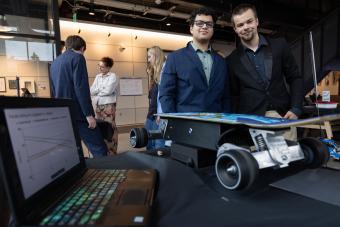
Diego Gutierrez Raghunath, left, and Josiah Hamm show off the electric-powered skateboard they developed with the support of the Mines Protofund.
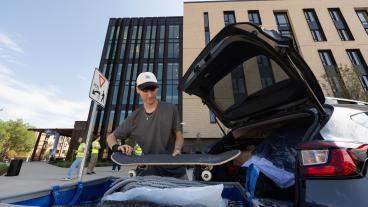
Diego Gutierrez-Raghunath chronically struggled to get to class on time. Others might consider simply leaving earlier, but the mechanical engineering major’s brain didn’t work that way.
With financing from Mines’ Entrepreneurship & Innovation (E&I) Prototyping Fund, Gutierrez-Raghunath joined forces with two fellow students to build a motorized skateboard.
Not only would their electric skateboard be high performing, but their plans would also be open source, so other boarders could make their own “get to class on time” sidewalk cruisers, too.
“I had never been on a board before, so it was a lot of trial and error,” Gutierrez-Raghunath said. “In fairness to me, we’ve all taken our share of falls working on this project. Fortunately, our injuries have been minor.”
With the goal of saving themselves funds and making their plans as affordable as possible, Gutierrez-Raghunath and his teammates Josiah Hamm, a computer science major, and Aaron Puffinbarger, a graduate student in mechanical engineering, decided to use an older model motor to power their board. “It’s not the best of the best, but we don’t need that,” Gutierrez-Raghunath said. “We just need something that gets the job done – powerful and efficient. This motor is both of those things, even if it is a little on the chunky side.”
As the team refined its ideas on how to build the best board possible, they ended up building out two boards, versions No. 1 and No. 2. Version No. 1 is an ultra-low-price one that cost the team just $350 to make. The more refined Version No. 2, which cost $1,300 to build, is more powerful. The motors on both boards are controlled by the same remote control.
“The most exciting part of the project for me has been helping Diego specify a battery for our board,” Puffinbarger said. “I was able to leverage my experience with surveying data to identify areas of highest elevation gradient on Mines’ campus, which informed the selection of a battery with sufficient output to ensure the skateboard can effectively climb hills.”
To keep costs down and learn as much as possible, the team opted to create their own wheels for Version No. 1 by pouring urethane into molds. “I was pleasantly surprised how well those wheels held up during testing,” Hamm said. “I really expected them to fall apart as soon as they were stressed.”
For the second iteration, the team also built their own trucks – the hardware connecting the wheels to the board – rather than opting for store-bought ones. They decided a spring-mounted design was a better route than using the rubber bushing-based design commonly found on non-motorized boards. Gutierrez-Raghunath said the spring-mounted design allows for easier switch outs when more or less spring strength is desired.
So, has the project been a success? Is Gutierrez-Raghunath getting to class on time now? He says it depends on the day.

About Mines
Colorado School of Mines is a public R1 research university focused on applied science and engineering, producing the talent, knowledge and innovations to serve industry and benefit society – all to create a more prosperous future.