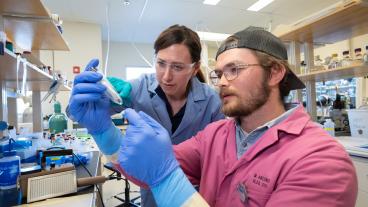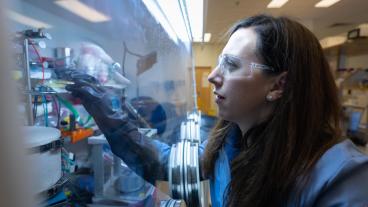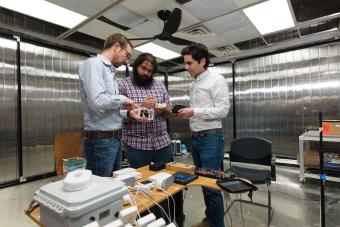
Associate Professor Paulo Cesar Tabares Velasco and graduate students Andy Gloor and Quin Guy inspect an indoor air quality data acquisition system designed to measure temperature, relative humidity, particulate matter, CO2 and other gases. These units are deployed across multiple homes in Denver, Colorado and in rural mountain areas in the state.
When power grids fail during sub-zero cold snaps or high winds threaten to topple power lines and spark wildfires, the vulnerabilities in the Unites States’ energy infrastructure become apparent. Climate-driven forces have become recurring stress tests for the vast network that powers homes, emergency services, industry, national defense and more.
Much of today’s energy system was designed for a different America: less densely populated, less electrified and far less interconnected. We are quickly outpacing our existing infrastructure with more demand for electric consumption from things like electric vehicles that get plugged in at home, massive data centers that operate around the clock and entire communities depending on continuous connectivity. The gap between what our infrastructure was built to handle and what it must endure continues to widen.
At their best, infrastructure failures are an inconvenience. At their worst, they expose deep disparities, disrupt supply chains and put communities at risk. They reveal which neighborhoods lack backup systems, which industries grind to a halt and which communities are left waiting the longest for recovery.
Mines researchers are examining these challenges and asking forward-thinking questions. Instead of repairing what breaks, how can we design systems that anticipate disruption? How can infrastructure absorb shocks, adapt in real time and recover faster while serving communities more equitably?
Across campus, breakthroughs in advanced materials, predictive analysis and resilient system design converge to answer those questions. Researchers collaborate directly with utilities, municipalities and community stakeholders to understand how people make energy decisions, what tradeoffs they face and where vulnerabilities are most acute. This on-the-ground insight feeds directly into the models, technologies and strategies developed in the lab, ensuring solutions are not only technically sound but grounded in real-world need.
Retrofitting homes to withstand energy challenges
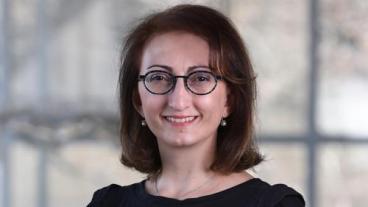
For Paulo Cesar Tabares-Velasco, Rowlinson associate professor of mechanical engineering, resilience begins close to home. Working within the Advanced Multiscale Building Energy Research Laboratory at Mines, he explores how residential buildings can evolve from passive energy consumers to active parts in a more resilient grid.
Tabares-Velasco is working directly with local urban and rural communities to electrify neighborhoods and improve efficiencies and resilience, in addition to improving health and comfort within homes. However, he must contend with a significant challenge: Across the U.S., millions of homes were built long before today’s demand for electrified technologies, climate disruptions and changing expectations for comfort and health. These residences are going to have to be updated and retrofitted with new technology that isn’t always compatible with current energy systems.
“Most of this kind of work so far has been done in new construction,” Tabares-Velasco said. “We can build a new house and give you all the features. But the real need is more in retrofits. How can you modify our existing housing stock? We are looking at different technologies and strategies to make homes more sustainable, affordable and resilient to extreme weather events and energy prices.”
One of the retrofits his research team is investigating is replacing gas water heaters—what most homes have in Colorado—with an energy-efficient heat pump electric water heater. But the problem is that electric heat pump water heaters are too wide and need more space than the closets that typically fit gas water heaters. “We’re trying to design a new water heater that can fit in these small spaces and still provide the same performance as a regular water heater,” Tabares-Velasco said.
But providing an electric water heater and integrating other electric appliances also creates another problem: substantially increasing the electric load on the home’s electrical panel and service lines. Many manufactured or multi-family homes—and even some small homes—have small electrical panels that were only designed for 50, 65 or 100 amps. With modern electrical technologies, that load is going to add up quickly.
“In Colorado, there is a state policy that requires a new 200-amp panel for most weatherization state-funded assistance projects to ensure there will be space for new loads,” Tabares-Velasco said. “It sounds like a great idea because it future-proofs a house. If you want something like an electric car, you’re going to have plenty of space. But when you’re thinking at a community scale, all the houses on the block are going to need a 200-amp panel, and the electrical utility will question whether they can handle the new load, from transformers to service lines and wires. Are they big enough to handle those loads? There are consequences upstream and downstream for doing that.”
In a small Colorado community Tabares-Velasco is working with, these 200-amp panels wouldn’t work given the strain it would place on the grid. He spent months presenting data to convince the state to waive the 200-amp panel policy in favor of installing 100-amp panels in the community instead.
The experience reinforced the idea that technical solutions are not enough when addressing energy challenges. Successful upgrades require working closely with local communities to understand what people need and what kinds of solutions will work best in a specific place.
“This cannot be done only be engineers,” Tabares-Velasco said. “We have to leverage the social behaviors of people within these communities—how people network, who people talk to, how they make decisions. That’s how we can come in with strategies and technologies that can work in retrofits.”
Those insights also shape how he thinks about the future of home energy systems. Rather than relying on a single approach, Tabares-Velasco believes communities should consider hybrid solutions that balance electrification with existing infrastructure.
“You can have a hybrid system where you have a heat pump in your house with a gas backup. When it gets too cold, you could switch to gas, which has a much lower impact on the electrical grid because you only have to run the motor that runs the fan for airflow. You will need a much smaller battery that could also run for a longer period of time,” he said.
Understanding those tradeoffs requires looking beyond individual homes and considering how choices ripple across the entire energy system.
“We need to understand in a more holistic view, from one house to another, what the impact on the local transformer and electrical grid is and how people make choices so we can empower people to make the right choices,” he said.
That also means changing how energy conversations happen with the public. “To sell energy, we need to understand what people care about and need. We need to talk about comfort, health, resiliency,” Tabares-Velasco said. “I think we’re making a mistake if we’re just talking about energy. If you talk about the other things, people start to pay attention to energy.”
Mitigating the impact of wildfires on infrastructure
While Tabares-Velasco is working to improve efficiencies and resiliencies within the nation’s energy systems, Qiuhua Huang, associate professor of electrical engineering, is focused on protecting that infrastructure from natural threats, like wildfire.
Longer dry seasons, hotter temperatures and expanding development along the wildland-urban interface have created conditions where power infrastructure and wildfire risk are tightly intertwined.
Utilities currently monitor weather conditions to anticipate wildfire danger. High winds, low humidity and dry vegetation can signal when downed power lines may spark a fire. But Huang’s research aims to make those assessments far more precise by looking beyond weather alone and examining the physical infrastructure itself.
Huang and his collaborators are building advanced modeling tools that analyze how environmental conditions interact with the grid’s physical components—poles, wires and surrounding terrain—to determine where ignition risk is highest. The models examine how extreme winds or other conditions might stress a pole or line, whether equipment could fail, what might happen next and how it affects nearby communities.
“Utilities mostly focus on the weather as the key factor in wildfire risk. If it’s a high-wind day and very dry, then we characterize this as a high-risk day. Mapping or considering the infrastructure is not directly in the equation,” Huang said. “One of the key things we consider is how the weather is impacting the power grid infrastructure at a more detailed level, like the poles and the lines because they might become ignition sources for wildfires under certain conditions.”
By combining infrastructure data with environmental conditions, Huang’s team can begin to quantify how likely an ignition event is and what might happen if one occurs.
“We’re capturing and quantifying that kind of behavior and risk. Then we have a downstream quantification of what if this ignition really happened? What would be the impact?” Huang said. “We have particular models that can capture the spread of the fire itself and then help us quantify the risk of the ignition.”
This deeper understanding of both grid-related ignition and fire behavior allows utilities to move beyond broad risk categories and toward targeted infrastructure management.
Today, one of the most common strategies utilities use to reduce wildfire risk is Public Safety Power Shutoffs (PSPS), where electricity is preventatively cut off during extreme conditions, sometimes for days at a time. While effective in preventing ignitions, these outages can affect thousands of people at once. Businesses must shut down, refrigerated food can spoil and go to waste, those relying on electrically powered medical equipment face life-threatening risks and more. Huang’s research is helping utilities move toward a more surgical approach.
“There are definitely some limitations in existing PSPS. One of those limitations is that we’re not able to be as precise. We’re working on methods that can help us shut down a particular section of a power line rather than a whole city, for example,” Huang said.
By combining infrastructure modeling, wildfire science and advanced risk analysis, Huang’s work aims to give utilities the tools they need to make smarter decisions before disaster strikes—reducing wildfire ignitions while keeping communities powered whenever possible. These insights could also help utilities tailor strategies for particular communities or regions that reduce tradeoffs for residents and businesses.
“Ultimately, our goal is making sure that utilities have the information about how particular lines or poles could cause wildfire risk so they can better control the power shutoff or enhance particular poles or several poles along a line because those have been identified to be higher risk than the rest of the line,” Huang said.
Together, the research underway at Mines—from resilient homes to natural disaster-ready infrastructure—points toward a future where energy systems are not only stronger, but more adaptable and more resilient to the growing challenges ahead.
Explore more of how Mines is leading the energy future at https://www.mines.edu/energy-research.

About Mines
Colorado School of Mines is a public R1 research university focused on applied science and engineering, producing the talent, knowledge and innovations to serve industry and benefit society – all to create a more prosperous future.