The rush is on: How Mines is positioned to lead the critical minerals conversation from exploration and processing to economics and end use
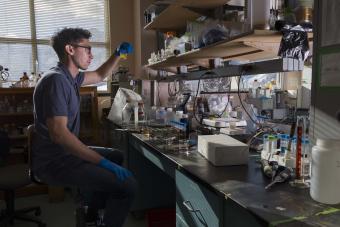
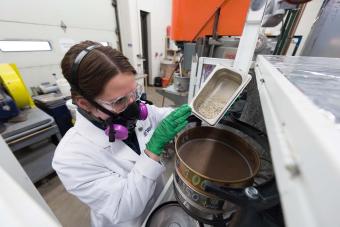
Mines researcher Charlie Depp PhD ’25 is investigating how to recover rare earth elements from acid mine drainage by forming manganese dioxide particles that can selectively capture them on their surface.
In a lot of ways, Colorado School of Mines was made for the current moment.
More than 150 years ago, the university was founded to support Colorado’s mining industry, building knowledge and solving challenges related to the state’s top mineral concerns of the day, gold and silver.
Over the years, that mission has expanded to support the evolution of industries in Colorado. The constant all those years? A world-renowned expertise in mining engineering, extractive metallurgy, mineral economics and more.
Today, a new mining rush is on, for dozens of minerals deemed “critical” to U.S. national security and the broader global economy, including those needed for energy systems, satellites, transportation, medical devices and defense technologies.
And through strategic focus and investments in world-class facilities, real-world innovation and workforce development, Mines is bringing to bear its legacy of tackling the world’s toughest resource challenges to lead today’s conversations on critical minerals in the U.S. and beyond.
“As a solutions-driven university with the top-ranked mining and metallurgy program, expertise and new graduates in all aspects of the critical minerals supply chain, and a 152-year history of working closely with industry, Mines is uniquely positioned to be the nation’s top university partner in this space,” Mines President Paul C. Johnson said.
A strategic vision
The 2025 Critical Minerals List from the U.S. Geological Survey identified 60 minerals from aluminum and antimony to the 15 rare earth elements to zinc and zirconium – as both essential to U.S. economic or national security and at risk for supply chain disruption. The U.S. Department of Energy also curates its own list, nicknamed the “Electric Eighteen” for their importance to energy technologies.
The supply chain challenges for each mineral are unique, as are the amounts needed, how each is currently sourced, additional options for securing the necessary supply and current market conditions (or lack thereof).
Or as Elizabeth Holley, professor of mining engineering and one of Mines’ critical minerals experts, puts it when she talks to government officials, policy makers and journalists: Critical minerals isn’t just one challenge. It’s 60 unique challenges.
“Today, more people in the world have heard of critical minerals than they had five years ago,” Johnson said. “But few understand the complexities beyond maybe having heard of cobalt or lithium and knowing they’re connected to vital technologies and complicated geopolitics.”
“From a national standpoint, you need a secure and abundant enough supply of the minerals needed by manufacturers and the defense industry that is affordable and that your adversaries can’t use against you,” Johnson said. “The interesting point is that the expertise in the U.S. in this area has atrophied significantly – there just aren’t that many people who know how to do this, and it’s very easy to manipulate the markets.”
That’s where Mines has a unique value proposition to offer – expertise along the full mineral supply chain, from exploration and extraction to processing and manufacturing to economics and end use, all under one roof, said Alicia Polo y La Borda Cavero, Mines’ new executive director for critical minerals strategy and advancement.
“There are not very many organizations that have an active presence in mining, extraction, processing, processing at different scales, processing of minerals and metals, manufacturing and end users,” Polo y La Borda said. “That is pretty unique.”
Fueling that expertise in exploration and mining is Mines’ No. 1 mining and mineral engineering program in the world, as well as active faculty-led research groups such as the Center to Advance the Science of Exploration to Reclamation in Mining (CASERM), a National Science Foundation Industry/University Cooperative Research Center aimed at transforming the way that geoscience data is used in the mineral resource industry, and the NSF Growing Convergence Research Team, which brings together 11 academic disciplines to evaluate new mines, byproduct recovery and mine waste as production pathways for critical minerals.
When it comes to mineral processing, the Kroll Institute for Extractive Metallurgy (KIEM) has been conducting research important to the minerals, metals and materials industries since 1974. In more recent years, KIEM has been a key partner in the Critical Minerals Innovation Hub at Mines, improving primary mineral processing and recovery, as well as secondary recovery through recycling and material characterization.
On the economics and policy side, Mines is home to the only mineral and energy economics graduate program in the U.S., and its master’s and doctoral students are active in CMI conducting economic analysis of material supply chains. Since 2021, the Payne Institute for Public Policy has been holding an annual Critical Minerals Symposium, bringing industry, government and academia together at Mines to discuss geopolitics, supply chains, sustainable mining, community engagement, permitting, investments, markets and more.
Downstream users – the manufacturers and tech companies who need rare earth elements for powerful magnets and gallium for high-performance semiconductors, for example – are increasingly becoming part of the conversation around critical minerals, as well, Polo y La Borda said.
“If you want steel, there’s an established market – you can go and know the price and buy. If you are a producer, you know that someone will take your material because it has so many applications,” she said. “But in critical minerals, it’s not like you open a lithium mine and just sell it, because the brine needs different processes and the end products vary. Most likely, the production has already been committed. The downstream customers require materials in a certain way at a certain time and place.”
“The audience has changed,” Polo y La Borda said. “We should not only be thinking about the upstream miners, the traditional stakeholders. We need to think about the downstream – they are the ones that are guiding the conversation about critical minerals now because they are the ones that need these materials. The people producing them are a lot of startups that have some technical knowledge and are struggling for financing.”
A 25-year veteran of the mining industry, Polo y La Borda has broad experience in mineral economics and market analysis, business strategy and development, mining policy and project management, previously holding roles in the private sector, government and academia in the U.S., South America and Europe. Most recently, she served as the director of outreach and research at The Copper Mark, an independent assurance framework for the copper industry that verifies responsible production practices. She also served as program manager for Mines’ Center for Mining Sustainability from 2019 to 2023.
“My job here at Mines is to connect what is happening in the labs with a wider audience,” said Polo y La Borda, who rejoined Mines in December 2025. “What I see for Mines is opportunity – to interact across departments, to learn from each other and to leverage the work that is being done here to make a real impact on this global challenge.”
That includes finding ways to amplify how Mines is positioned to make an impact, not only in terms of expertise on the end-to-end value chain but also the university’s strengths in workforce development, innovation to commercialization and world-class facilities.
A strategic hub for research, commercialization
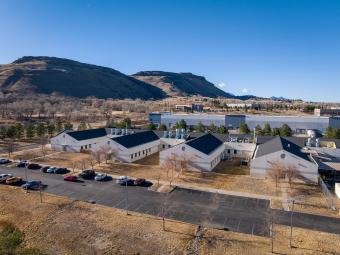
At the center of these efforts is a new facility that will act as a hub for university-industry-government-startup partnerships that lead to innovation and accelerated commercialization around critical minerals supply chain challenges.
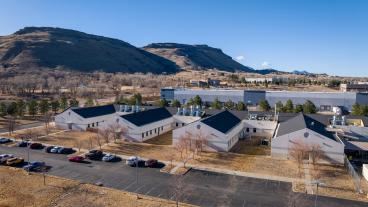
Mines recently purchased the 50,000-square-foot building in Golden’s Coors Technology Center. Located 10 minutes away from the main Mines campus, the facility includes laboratory, open room, and high-bay space, providing opportunities for all stages of innovation from bench-scale proof-of-concept tests to pilot/demonstration-scale projects.
“Our plan is to establish a dynamic hub that accelerates innovation and commercialization – to provide the solutions needed to solve our nation’s materials supply chain challenges,” Johnson said. “The key is to foster a collaborative environment where the co-location of startups, established companies, shared resources and the expertise Mines’ faculty and alumni bring creates synergies that lead to faster creation of the critical minerals supply chains that U.S. industry needs.”
Johnson likens the concept to a “critical minerals technology food court,” where instead of choosing between burgers and pizza, entities with critical minerals-related challenges can come talk to multiple experts about potential solutions and partnerships, all in one central location.
“Why do you walk into a food court? You walk into a food court because you’re hungry. You want something but maybe you’re not quite sure what you want,” Johnson said. “The analogy here is that people will be seeking help and connections to experts but perhaps don’t know exactly what or who they need.”
Mines is currently reviewing inquiries from potential industry partners, startups and other stakeholders interested in advancing their ideas and companies within the new hub.
“The vision is that a year from now, the rooms will be occupied by startups, some corporate R&D efforts, plus some Mines technology that is ready to move toward commercialization,” Johnson said. “This is not going to be a typical university research building – that’s the last thing that we want.”
The hub joins other unique Mines facilities – the Edgar Experimental Mine, Explosives Research Laboratory and the forthcoming U.S. Geological Survey Energy and Minerals Research Facility, as well as the Beck Venture Center, among them – to create a one-of-kind ecosystem for critical minerals innovation and commercialization.
A catalyzing gift
Helping to stand up Mines’ critical minerals initiative are lead gifts from Mines Board of Trustees chairman Bruce Grewcock ’76 and Andy Swiger ’78.
“The world needs new research and new ideas on how to produce critical minerals effectively, efficiently and in a sound environmental way. Mines has a real ability to make a difference in this space – we’re the premier earth sciences university in the world. I am excited to help jumpstart this new initiative.” - Bruce Grewcock ’76, chairman of Peter Kiewit and Sons’, Inc
“Economic sourcing of critical minerals is one of the truly important strategic challenges of our time. Mines has decades of experience, expertise and know-how across the entire suite of capabilities that make up the critical minerals value chain. Additionally, Orediggers are known for a strong culture of problem solving. It is imperative that Mines attract the support necessary to assure a leading role.” - Andy Swiger ’78, retired Exxon Mobil executive
To learn more about critical minerals at Mines, go to criticalminerals.mines.edu.

About Mines
Colorado School of Mines is a public R1 research university focused on applied science and engineering, producing the talent, knowledge and innovations to serve industry and benefit society – all to create a more prosperous future.