Mines students tackle biomass challenge in partnership with local government and community organizations
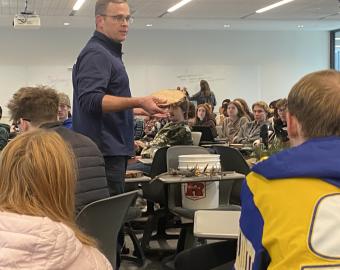
Jason Puffett, division chief of Evergreen Fire's Wildland Division, shows School of Mines students the types of forest waste materials for which they’re trying to find long-term solutions.
Photo courtesy of Jane Reuter, Canyon Courier
Colorado School of Mines students are putting their engineering and entrepreneurship skills to the test to transform the byproducts of forest fire mitigation projects into viable business opportunities.
The six-week Innov8x Biomass Challenge is a collaboration between Evergreen Fire/Rescue, Leadership JeffCo, Red Rocks Community College, Jefferson County, Evergreen High School, Matrix Owl and Mines’ McNeil Center for Entrepreneurship and Innovation
Biomass is material generated through wildfire mitigation efforts like forest thinning. Rather than treating the woody debris and other biofuel as waste, the Mines students are being asked to explore how these materials can be repurposed into marketable products that deliver economic, environmental and community value.
“It’s about making a business case for biomass, the products that come from fire mitigation,” said Lia Franklin, acting director of the McNeil Center. “How can we repurpose all this biofuel?”
The effort comes at a critical time for Jefferson County, which has faced increasing wildfire threats in recent years due to drought, dry vegetation and high wind events along Colorado’s Front Range. These conditions have heightened the risk of fast-moving fires in the wildland-urban interface, underscoring the importance of proactive forest thinning. However, those efforts generate significant volumes of biomass that must be managed cost effectively — creating both a challenge and an opportunity.
“Our community faces a very high wildfire risk, so we need innovative ideas that help all of us strengthen mitigation efforts, improve forest health, slow the spread of mountain pine beetle, and reduce wildfire risk,” said Jason Puffett, division chief of wildland for Evergreen Fire Rescue. “We’re excited to partner with Colorado School of Mines, Evergreen High School and the entire team to see what these talented students develop.”
Under the direction of Ali Kerr and Mairead Case, both teaching assistant professors of humanities, arts and social sciences , Mines and Evergreen High School students are spending six weeks evaluating supply chains, identifying potential value-added products and developing commercialization strategies. Teams will examine pathways for collecting, processing and converting biomass feedstocks into useful materials, energy products or other innovative applications.
The students will help address a key barrier to wildfire mitigation: economic feasibility. Creating sustainable markets for mitigation byproducts could reduce disposal costs, incentivize continued forest management and strengthen regional resilience.
The McNeil Center continues to expand experiential learning opportunities that connect students with real-world challenges and community partners. Through initiatives like the Innov8x Biomass Challenge, Mines equips future leaders to translate technical insight into practical, market-driven solutions.
The Biomass Challenge ends on April 3, 2026 when the Mines students present their proposed solutions. “It’s a lot with the course load I have, so it seems a little daunting,” mechanical engineering sophomore Shunya Kawazoe told the Canyon Courier newspaper. “But it’s real, a real experience.”

About Mines
Colorado School of Mines is a public R1 research university focused on applied science and engineering, producing the talent, knowledge and innovations to serve industry and benefit society – all to create a more prosperous future.