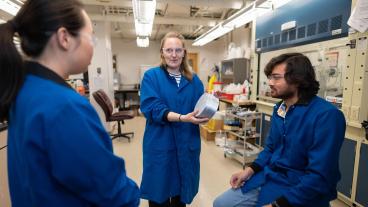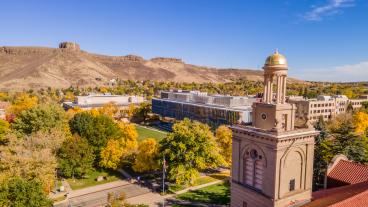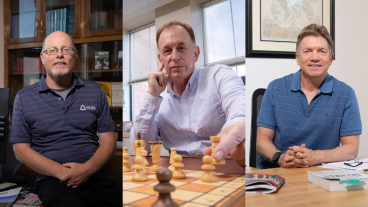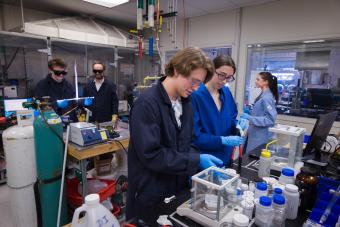
Mines students work in teams in the lab with Kamil Ciesielski, research assistant professor of physics, as part of a Vertically Integrated Projects for Experiential Research (VIPER) project to discover new quantum materials. Through VIPER, undergraduate students gain not only research experience but also leadership skills and the opportunity to contribute to cutting-edge topics like quantum computing, robotics, AI, space exploration and more.
Colorado School of Mines is advancing a new model for undergraduate engineering education through its integration of technical rigor with entrepreneurial mindset, character development and authentic experiential learning across the curriculum.
This work builds on those things that already distinguish Mines from other schools: its unique collaborative, rigorous environment that prepares future engineers and scientists to solve complex problems, create value, lead with purpose and contribute to a more prosperous future.
Accelerating the development and implementation of this new model is a transformative partnership with, and financial support from, the Kern Family Foundation, which works nationwide to empower the rising generation of Americans to build flourishing lives anchored in strong character, inspired by quality education, driven by an entrepreneurial mindset, and guided by the desire to create value for others. Mines is also a partner in the Kern Entrepreneurial Engineering Network (KEEN), a national network of 70 universities with a shared mission to graduate engineers with an entrepreneurial mindset.
“We are deeply grateful to our partners in the Kern Family Foundation for their support in bringing our shared vision for engineering education and engineers-of-the-future to reality,” Mines President Paul C. Johnson said. “We hope that this new approach to engineering education – which combines a technical education, entrepreneurial mindset growth, hands-on-learning and character development – will prepare engineers for success and positive impact to industry and society in a rapidly changing world. Mines will share lessons learned with other universities and aims to be a national resource in engineering education innovation – building on our 152-year history and well-established reputation for producing distinctive industry-ready graduates.”
Through the initiative, Mines is implementing a coordinated approach to curriculum development that supports collaboration among faculty teaching across cohesive multi-course sequences, in three distinct but interconnected focus areas:
- Entrepreneurially Minded Engineers who demonstrate curiosity, make connections across disciplines, and create value for others
- Character-Driven Leadership that develops integrity, honesty, responsibility and judgment to contribute positively to society
- Ideas to Reality, a commitment to authentic experiential learning that enables students to pursue projects worth doing and bring meaningful ideas to life
Over the next three years, Mines will:
- Engage at least 90 faculty members across at least six departments to transform student content around entrepreneurial mindset and experiential learning, impacting at least 2,000 engineering undergraduates.
- Develop and integrate character formation experiences and models within the context of a STEM school that will be piloted and evaluated by at least 30 faculty members to impact 1,000 engineering undergraduates.
- Enable Mines faculty and staff to lead others with these models, including collaborating with other KEEN partners directly and, more broadly, leading conferences, external presentations and faculty development initiatives.
Central to the initiative is the Trefny Innovative Instruction Center, which partners with Mines faculty and academic leaders to design evidence-based teaching innovations and support sustainable curricular transformation. Faculty participants will engage in multi-day workshops and collaborative year-long course design projects. Faculty development cohorts will bring instructors together to align learning outcomes, share practices and design experiences that reinforce key habits of mind throughout the undergraduate curriculum.
Those habits include navigating complex real-world challenges, integrating technical knowledge with contextual awareness and stakeholder needs, developing professional identity grounded in purpose and responsibility, and translating ideas into tangible outcomes through design, research and innovation experiences.
"We aren’t just teaching students how to solve equations – we're teaching them how to identify the problems worth solving," Mines Provost Stefanie Tompkins said. "Our faculty are leading a shift in teaching that ensures that when a student graduates, they possess both the technical skills and the character-driven mindset to create lasting value for society – not just now but throughout their careers."
Pilot program highlights potential for impact
A 2025-2026 pilot program in the Mechanical Engineering Department – the largest academic department at Mines and one of the largest mechanical engineering departments at a single campus in the U.S. – demonstrates the scale of the approach.
In Fall 2025, 17 faculty members collaborated to intentionally integrate entrepreneurial mindset habits across five coordinated course sequences representing 16 distinct courses and 89 course sections. As a result, 1,962 unique undergraduate students engaged in coursework designed to strengthen these habits, with 1,171 students encountering them in multiple courses, reinforcing their ability to apply these ways of thinking across contexts.
Building on these early results, Mines will host workshops in May bringing together teams of Mines faculty to design coordinated approaches across course sequences and programs. The 2026 workshops will focus on internal collaboration, enabling faculty to develop shared learning outcomes, align course experiences and implement changes that reinforce student learning across multiple years of the curriculum.
Mines plans to expand this model to include external participants beginning in 2027, supporting broader dissemination of approaches developed and tested at Mines and strengthening collaboration across the engineering education community.
"Experiential learning reaches its full potential when it moves beyond isolated activities and becomes an integrated process where students understand their values, create value for others, and engage in a range of opportunities to do so,” said Jack Bringardner, Ben L. Fryrear Chair for Innovation and Excellence at Mines. “When this is intentionally woven throughout the curriculum, students don’t just build skills, they develop the confidence, judgment, and sense of purpose needed to thrive in their lives and careers."
Building on the Mines Advantage foundation
This work reflects Mines’ commitment to helping students reach their full potential as engineers and leaders. By pairing technical rigor with value creation, character development and experiential learning — what we call the Mines Advantage — students are prepared to identify opportunities, develop solutions and contribute meaningfully to their communities and professions. Mines continues to strengthen its role as a national convener in engineering education and engineering studies, advancing research-informed, scalable approaches to student-centered, future-oriented learning.
The initiative builds on existing strengths across Mines, including interdisciplinary design courses, Vertically Integrated Projects and undergraduate research, industry-sponsored projects and active-learning environments that emphasize creativity, collaboration and real-world relevance.

About Mines
Colorado School of Mines is a public R1 research university focused on applied science and engineering, producing the talent, knowledge and innovations to serve industry and benefit society – all to create a more prosperous future.