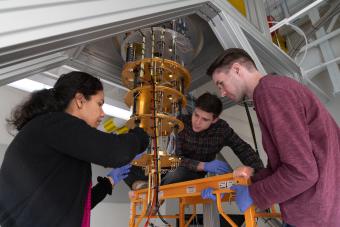
Meenakshi Singh, director of the Quantum Engineering program, works with PhD students Sam Saiter, center, and Bradley Lloyd, right, on a dilution refrigerator in a quantum lab on the Mines campus.
Technology can change rapidly, but Colorado School of Mines prepares students to respond to those changes and lead the future.
That’s why Mines created one of the first quantum engineering master’s degree programs in the U.S. more than five years ago. Graduates of the program are already making an impact in the quantum industry, especially here in Colorado.
“Our students are particularly prepared for the workforce due to strong connections with the quantum industry and research partners, paired with their drive and ingenuity to innovate, work hard and produce results starting from day one,” said Wendy Winter-Searcy, director of the Mines Career Center.
While still a burgeoning market, Mines graduates from the master’s program have been in high demand. The program has a 95 percent positive outcome rate, which is higher than average, Winter-Searcy said. Top industries that recruit Mines quantum students include quantum companies of course, but also aerospace, tech and the public sector, according to Mines Career Center data.
Established in 2020, the graduate program was a natural outgrowth of Mines’ investment in quantum starting nearly a decade ago – much earlier than most other institutions, said Fred Sarazin, director of quantum at Mines. One vital reason was Mines’ connection with industry leaders, both locally and around the world, whose insights were instrumental in building the quantum program.
“Mines is the institution that can pull this off,” Sarazin said. “It’s complicated to launch new programs, but our relationships and connections mean we are able to create quantum programs with the needs of industry in mind.”
Those industry needs include hardware and software engineers who understand that building a quantum computer is a complex, interdisciplinary challenge that will require contributions from a wide array of fields, not only physics but also materials science, electrical engineering, computer science and mathematics.
To that end, students in both the thesis and non-thesis Master of Science programs are strongly encouraged to take at least 9 of their 30 credits in a discipline outside of their undergraduate major to broaden their perspectives.
Students in the program also specialize in one of two tracks: Quantum Engineering Hardware or Quantum Engineering Software. The hardware track focuses on experimental techniques relevant to quantum technology, while the software track focuses on theory, algorithms and simulation.
Meenakshi Singh, director of the Quantum Engineering program, said students on either track learn skills that will prepare them for a wide range of careers, whether in the expanding quantum market or elsewhere.
“In quantum, on the hardware side, you learn about lasers, and the optics industry needs those skills. You learn about nanofabrication, and microchips are needed. You learn about cryogenics, MRIs, et cetera. There is just so much that our students learn that is applicable to so many fields that you don’t have to worry about finding a job. On the software side, there is a lot too. There are quantum algorithms, cybersecurity, encryption, stock market predictions,” Singh said. “The range of things that our students end up doing is mind boggling.”
Creating New Ventures
The diversity of opportunity is a big reason Connor Denney decided to pursue his master’s degree in quantum engineering. As an undergraduate student at Mines, he studied electrical engineering and wanted to find ways to break out of the well-trod pathways that discipline offered.
“At some point, I felt like I wanted more of a challenge," Denney said.
His mentors connected him with Singh, and he began working on one of her research projects.
“It was a really undergrad friendly project where I got to touch a lot of elements of quantum, and I really liked it. I was already thinking about graduate school and decided to specialize in quantum because it’s at the intersection of so many things I’d come to enjoy,” he said.
The quantum engineering master’s program allowed Denney to dive further into more specialized uses of quantum technology – and better understand which areas have a need for more expertise.
“You work with people on quantum theory and superconducting systems, and everyone has different backgrounds,” he said. “Some people in pure physics, some in optics, some from materials science. And one thing I found that was lacking was radio frequency engineers.”
To fill that void, Denney connected with classmate Logan Pauli to co-found Bifrost Electronics, a company that develops RF hardware used in quantum computing systems. Pauli serves as the chief technical officer while Denney is head of research and development, a role that pairs well with his other current venture, working on a PhD in electrical engineering at Mines.
“One of the great things about the master’s program is that you get to meet people from different backgrounds who are all interested in quantum,” Denney said. “Logan and I talked pretty consistently about the quantum supply chain, and it was his theory that if we look at a quantum computer, we should ask what parts are solved and what problems need to scale up.
“The soft problems that need to scale include room temperature readout electronics. But there was a gap in the readout chain where it appeared as if the research to make it a solved problem was there, but it wasn't actually filled in the market yet. So, we applied for a grant together to develop the readout technology, with the intent to make it scalable, and that was the start of Bifrost.”
Mentorship from industry
To build Bifrost from an idea born during their master’s program into a viable company, Denney and Pauli connected with Corban Tillemann-Dick, founder and CEO of Maybell Quantum, for advice.
Founded in 2021, Maybell Quantum, has been a strong Mines partner for years. The company has utilized Mines facilities to build quantum refrigerators and frequently recruits Mines students, Tillemann-Dick said.
“Mines trains people who know how to actually solve problems and can tackle them from different angles,” he said. “It’s the top place we hire from.”
Maybell is a part of Elevate Quantum, a regional consortium of universities, companies and organizations working together to advance the future of the quantum industry in the Mountain West.
Named a Designated TechHub by the U.S. Department of Commerce’s Economic Development Administration, Elevate Quantum, along with Mines, is creating Quantum Commons, a 70-acre campus in Arvada that will foster growth in the quantum sector. A 13,000-square-foot quantum commercialization lab opened this spring.
In the future, Mines will be a key partner at Quantum Commons, with research and hands-on learning opportunities available to quantum students, Sarazin said. Those students will not only get to learn in world-class facilities but make connections in the local quantum industry, one of the nation’s largest.
“It just makes sense for Mines to have this program, with the Mountain West having the largest quantum workforce in the country,” Sarazin said. “Colorado and New Mexico have so much expertise and a lot of quantum-adjacent companies. There’s a dire need for engineers who can understand quantum, from basic physics all the way to the engineering and manufacturing aspect. Mines has the right resources and interdisciplinary offerings to get it right.”
Tools to build the future
It’s those resources that are a key part of what makes the quantum engineering program successful, Singh said Students in the program have access to laboratory spaces and cutting-edge equipment that allow them to get hands-on experience, not just learn concepts.
“This really is a hands-on degree program,” she said. “Our students get to spend a lot of time in the lab, working directly with their professors. The program is really aimed at making you an engineer who can solve problems in quantum today.”
The interdisciplinary nature of the program means 22 faculty from across seven departments at Mines teach in the quantum engineering program. Research projects and coursework are intentionally cross-collaborative, so students can easily work across disciplines, with a focus on how those apply to building the growing quantum engineering industry.
“That’s the point of getting into the field right now,” Singh said. “Our students are going to be part of constructing the future of quantum.”

About Mines
Colorado School of Mines is a public R1 research university focused on applied science and engineering, producing the talent, knowledge and innovations to serve industry and benefit society – all to create a more prosperous future.