Vehicle performance testing system wins top honors at Spring 2026 Capstone Showcase
Sponsored by Mines' Mechanical Engineering Department, the team created a system that evaluates vehicle performance without needing full on-track testing
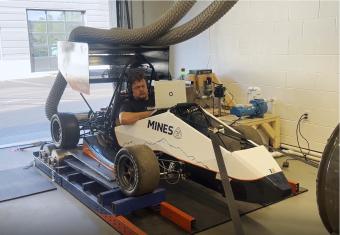
A system to evaluate vehicle performance in a safe, controlled environment won first place at the Spring 2026 Capstone Design Showcase, an exhibit of the year-long design projects completed by seniors at Colorado School of Mines.
The dynamometer – designed and built for automotive program in Mines’ Mechanical Engineering Department – measures the torque and rotational speed of an engine to determine its power, calculates vehicle performance while also supporting brake pedal and caliper testing, all to help engineers make better decisions before track testing.
"We spoke with several stakeholders in the Mines automotive program and quickly recognized there was a need for in-house powertrain characterization equipment,” said team member Liam Homburger. “We realized we could design and build a vehicle dyno that could outperform similar dynos local to us. We were able to combine full vehicle, engine and brakes testing all into one set of instrumentation.”
Along with Homburger, the winning team included Sam Robie, Brennan Koontz, Aidan Bennett, Flavio Rios-aldava, Steven Tran, Trevor Hart and Nathan Burns. The team’s faculty adviser was Brian Gockel, professor of practice in mechanical engineering.
Vehicle Dynamics Test Hardware’s design was the result of collaboration with the automotive program and the Mines Formula SAE team, which designs and builds cars for race competitions, and was largely created in the Labriola Innovation Hub and other facilities on campus.
Homburger said the team hopes their system can benefit not just Mines, but other schools in the area, fostering collaboration in the future.
“Winning the Capstone Design Showcase meant a lot to our team and to our clients. When we started this project, we really wanted to make something that would be useful for the courses and clubs of Mines Automotive for years to come. We had first place as a secondary goal. Ultimately, there were a lot of great projects, and it is an honor to be selected as the winner from that amazing group,” Homburger said.
Capstone Design is a signature student experience at Mines that tasks student teams with producing creative, client-driven solutions to real-world problems. Paired with sponsors from industry, government and the broader community, students combine their knowledge in civil, electrical, mechanical, environmental and design engineering to create projects that address realistic, multidisciplinary challenges. The year-long experience ends with Capstone Design Showcase, where teams present their ideas and prototypes to sponsors, judges and members of the Mines community.
Second place at this semester’s showcase went to Smart Pick for Rock Cutting, a custom sensing solution for rock cutting that captures real-time interaction data at the rock-pick interface. Team members included Ben Bergeron, Milos Jankovic, Sophia Mimlitz, Kobe Prior, Jared Richel and Graham Walter. Roxann Hayes served as faculty adviser.
Third place went to Solar Road Builder for the Moon, a system that can use regolith, or lunar soil, to fuse into a durable, road-like surface. Team members included Aidan Staszak, Brian Durland, Cameron Hinkle, Charlie Yuroff, Estevan Gonzalez, Matthew Carcia, Neel Jasti, Owen Jeffcoat, Simon Igel, Taylor Wood and Trevor Maybach. Greg Proulx served as faculty adviser. Capstone projects were also recognized for their innovation, societal impact and proof of concept:
Best Innovation: Scale Locomotive Battery to Hydrogen Fuel Cell Conversion
Best Human Systems: Six-String Guitar Adaptation
Best Societal Impact: Smart Environmental Monitoring for Job Site Safety
Best Environmental Impact: Addressing Methane Leakage from Abandoned Oil Wells with Biochar Cement
Best Proof of Concept: TH Intelligent Storage and Management System
The Spring 2026 Broader Impact Essay winner: Danielle Kosowsky for “Broader Impacts: Legacy Infrastructure”

About Mines
Colorado School of Mines is a public R1 research university focused on applied science and engineering, producing the talent, knowledge and innovations to serve industry and benefit society – all to create a more prosperous future.