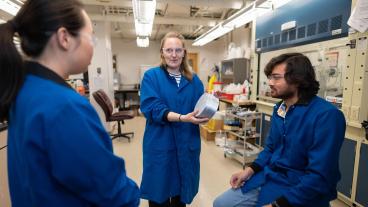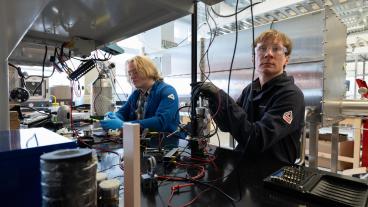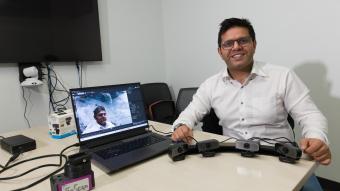
Navdeep Bhusri, a graduate student in Advanced Manufacturing, created a prototype of a 3D facial scanner that can make dental care technology more accessible. (Photo by Tim Meyer/Colorado School of Mines)
After more than a decade of working in dentistry, Navdeep Bhusri decided he wanted to study engineering.
“I was always interested in the technical part of things, like how does the dental drill work? How do the sensor systems work?” he said.
Accepted into Colorado School of Mines’ Advanced Manufacturing graduate program, he moved from India armed with an idea he first had while practicing dentistry among lower-income populations for the past 8 years in Cambodia: If dental technology was made in a more affordable and accessible way, more people around the world could access dental care.
Thanks to the Labriola InnoHub E&I Prototyping Fund, he’s getting closer to that idea becoming reality.
The ProtoFund is a semester-long program that supports students who are passionate about building new technology or products. Students in the program get connected with faculty and mentors and can receive up to two rounds of funding to build prototypes. The program is run by the Labriola Innovation Hub, where ProtoFund students have access to high tech, wide-ranging resources and tools to bring their ideas to life.
“Labriola is one of the best spaces that Mines has,” Bhusri said. “I did my dental and postgraduate training in five different universities all over the world, but I haven’t found any space as comprehensive as Labriola that connects the whole campus together. It brings people from all the departments and backgrounds together and it’s just so wonderful to work there.”
Bhusri’s idea sprang from finding out how expensive 3D scanning equipment can be. Even on the low end, clinics are looking at spending thousands of dollars, he said. In places like Cambodia and India, that’s out of reach for many dental clinics, especially in lower income areas.
His idea? Make scanners that work through simple cameras, set up in a circular array. These scanners can capture 3D images quickly and simultaneously without any kind of physical contact with the patients. Bhusri said he focused on both affordability and ease of acquiring the technology, instead of building a bigger, more expensive scanning device.
“A lot of times companies talk about scaling up technologies, but my direction is exactly the opposite. I want to scale down, to make them accessible to the public who are the real benefactors,” Bhusri said.
He learned about the ProtoFund by chance during his first month as a Mines student after reading an entry in the Daily Blast, Mines’ daily campus newsletter. It sounded like the perfect opportunity to start creating the 3D scanner he’d been imagining. Bhusri was accepted for the Spring 2025 cohort and then again for Fall 2025.
“I had an idea for an intra-oral scanner, but that would be a more robust and long-term project,” he said. “My idea for a facial scanner I thought could be possible to prototype in a year.”
The ProtoFund not only provided Bhusri with funding -- applicants can apply for up to $500 for the first round and then re-apply for up to $2,000 if they participate in a second semester, as Bhusri did -- and access to equipment he needed to build his prototype, but also with the right mentors to guide him along the way. Pivotal in their assistance were Michael Sheppard, assistant professor of engineering design & society, Craig Brice, director of the Additive Manufacturing Program and Bhusri’s MS adviser, and Melissa Krebs, associate professor of chemical and biological engineering, who has experience prototyping and bringing to market a product in the biomedical industry.
Bhusri will be graduating with a MS in advanced manufacturing in December. In January he will be joining the faculty at the University of Alabama at Birmingham (UAB) as an assistant professor, but he said he will continue to keep his connection to Mines strong. He, Brice, and Krebs have also been working on a different research project to create functionally graded materials through additive manufacturing for regeneration in patients with cleft palates, which he will continue as a long-term collaborative project between Mines and UAB. He also plans to continue with his 3D scanner project and see where he can take it.
Going back to school almost after a decade, Bhusri said, was not easy, especially going into a different field than the one he’d been working in professionally for so long. But he’s glad he can now tap into his expertise in both the dental and engineering fields and be part of the connection between the two.
“Doing this kind of midcareer transition, it’s easier said than done,” he said. “But I think of myself as a bridge to both sides, having been a clinician and studying engineering design. I would recommend and encourage anyone else who is thinking of doing the same. It isn’t an easy transition, but it’s highly fruitful. Your varied skills, your applicability to multiple projects, it can be unmatched.”

About Mines
Colorado School of Mines is a public R1 research university focused on applied science and engineering, producing the talent, knowledge and innovations to serve industry and benefit society – all to create a more prosperous future.