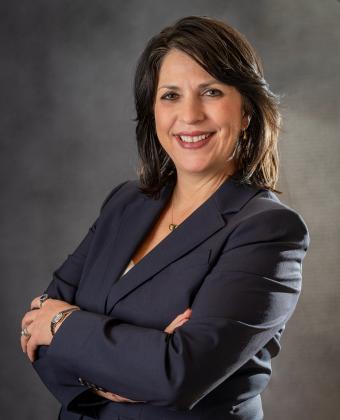
When Crystal Heter ’99 began her engineering career with KN Energy, she wasn’t focused on leading thousands of people or overseeing billion-dollar projects. She simply wanted to put her degree to work. As the company evolved, first becoming Kinder Morgan and later Tallgrass, Heter’s role grew right along with it.
Over 26 years, she has advanced from mapping and drafting, to risk and project management, up to account director and then to president of the gas transportation segment of Tallgrass’ operations. Now, as the company’s executive vice president and chief operating officer, Heter has come full circle, bringing her operations and commercial experiences together. This year, she was also named one of Oil and Gas Investor’s Influential Women in Energy.
We asked Heter about what it’s like to grow with an evolving organization and her thoughts on navigating a shift into a leadership role. Here is what she had to say.
Mines Magazine: You’ve spent time in roles that span nearly every aspect of the natural gas business and have led some significant projects, like the Rockies Express Pipeline. What interests you about working in the energy industry?
Crystal Heter: On the outside, people talk about these projects on a macro scale. Take the Rockies Express Pipeline, for example. Most folks focus on the 1,700-mile, large-diameter pipeline stretching across nearly the entire country. But what fascinates me is that it’s not a massive monolithic structure—it’s a system-built inch by inch, landowner by landowner, community by community. In the process, you come to understand what matters most to people, whether it’s working the land, raising cattle or creating income through leasing. That perspective has stayed with me.
And now, as a leader, I’ve come to appreciate not only the individual priorities of landowners and communities but also the broader quality of life that energy brings to all of us. While we’re committed to leading clean energy solutions, we also recognize that the reliability of today’s energy sources is essential to sustaining that quality of life.
MM: What has it been like to grow alongside a company in this field, and what moments stand out to you?
Heter: One of my biggest revelations was understanding that while I could build pipelines, and design compressor stations, I didn’t understand how we’re making money doing it. I had this deficit in my professional experience, so I asked if I could have an opportunity to see the business side of the shop and spent the next 10 years working my way from an account director up to president of the gas transportation segment. It was phenomenal for progressing my career and gaining a broader, more holistic understanding of the industry.
MM: How do you build strong and resilient teams when managing complex projects and meeting today’s energy demands?
Heter: I’ve found that success really starts with clear communication and a commitment to collaboration. My leadership philosophy is grounded in the idea that I don’t have all the answers—in fact, I have very few. That’s why I prioritize listening to input from across my team, then making the decision that needs to be made, embracing the responsibility that comes with it and circling back to explain the “why.”
It’s unrealistic to expect people to pull in the same direction if they don’t understand the reason behind the decision. Even if someone disagrees, giving them the opportunity to understand why the decision was made allows them to respect it, embrace it and move forward with the team.
MM: What advice would you give someone who’s navigating the transition from being an expert in their field to becoming a leader of people or strategy?
Heter: Learning to delegate is one of the hardest transitions, especially for strong performers. You have to let go of the instinct and the satisfaction that comes from producing the work yourself. Early in your career, you can point to a report, analysis or model and say, “I did that.” As a leader, the work becomes less tangible. You don’t get that same sense of closure from finishing a task.
Instead, the shift is about asking, “How can I help my team achieve their best?” Doing the work for them isn’t the answer. Leading requires being intentional about giving people the runway to grow, develop and succeed on their own.
MM: Why do you think Mines graduates are typically well-suited for leadership roles in industry?
Heter: I think the greatest skills Mines taught me are attention to detail and resiliency. The workload is intense, and the expectations are precise, forcing you to juggle multiple deliverables at once. That experience shapes not only strong performers but also future leaders. We’re fortunate to be so close to Mines where we can actively recruit talent, and we are proud to have many Mines alumni within our organization.
About Mines
Colorado School of Mines is a public R1 research university focused on applied science and engineering, producing the talent, knowledge and innovations to serve industry and benefit society – all to create a more prosperous future.