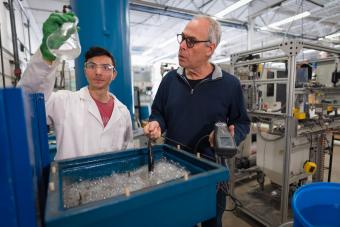
Graduate student Louis Miyasaki and Professor Tzahi Cath work with the electrocoagulation pilot system in the Center for a Sustainable WE2ST at Mines.
By Jen A. Miller, Special to Mines Research
Modern society runs on two essential resources: energy and water. Energy powers our homes, industries and infrastructure. Water sustains people, agriculture and ecosystems. Yet, these systems are deeply intertwined, each relying on the other to keep society running.
“You need water in order to produce energy, and you need energy in order to treat water,” said Tzahi Cath, professor of civil and environmental engineering at Mines and co-director of the Colorado Center for a Sustainable WE2ST.
Right now, both systems are under strain.
According to the U.S. Geological Survey, Americans use 322 billion gallons of water a day. Pressure on that supply is expected to only increase as demand rises and climate change reshapes water availability and quality. The U.S. Forest Service projects that nearly half of the country’s 204 freshwater basins might not meet monthly water demand by 2071.
At the same time, an abundant supply of clean, potable water is needed to meet growing energy needs. The U.S. Energy Information Administration estimates that energy demand will continue to increase, by 1 percent in 2026 and 3 percent in 2027.
The tension between these systems is only intensifying. Emerging technologies, like artificial intelligence, depend heavily on both. “All these things take money. They take energy. They take chemicals. They take labor. And you cannot disconnect these two things,” Cath added.
Mines researchers are working to transform this growing competition between water and energy systems into a more balanced relationship, finding new ways to help them operate together more efficiently while reducing the pressure they put on each other.
That work is especially critical in Colorado, said Josh Sharp, professor of civil and environmental engineering. “We're looking down the barrel of a potentially rough summer in Colorado in terms of water availability with this historically low snowpack, which makes using alternative and less pristine water sources like treated wastewater and brackish waters all the more important to have a sustainable water supply,” he explained.
This becomes even more important as demand for water to support emerging technologies continues to grow. That’s especially true for data centers powering artificial intelligence, which require large amounts of energy to operate and water to keep systems cool.
“We’re building some of these data centers in dry places, and there’s going to be a massive demand to have a water supply to cool those data centers,” said Sharp. “At the same time, we have a water supply that we need to protect and not make it worse.”
Other energy technologies, like nuclear power, hydraulic fracturing for oil and gas and mining and hydrogen production, all require water, too.
That demand feeds back into the energy systems as well. Treating water so it’s safe for drinking, agriculture and industry requires significant energy, as does transporting it to where it’s needed.
Mines researchers are developing new methods to reduce strain on both water and energy resources. That includes exploring nature-based approaches that could be used “as a sustainable alternative water treatment system that potentially requires a lot less energy than traditional water systems,” said Sharp.
His research focuses on biochemical processes that can more efficiently clean water. One approach involves unique treatment wetlands that are constructed to use diatoms and other microorganisms to clean water of emerging trace pollutants, like pharmaceuticals and metals. He’s been testing these systems in Southern California and in a lab on the Mines campus, and he’s also exploring how they can be integrated into nature-based water treatment in Peru and other nations in Latin America.
Other researchers, like Cath, are exploring technologies like potable reuse of reclaimed water and advanced membrane technology for desalination of hypersaline streams.
While these technologies exist, they require significant energy. Reverse osmosis, for example, requires pushing water through a “very tight barrier,” said Cath. To do that, “you need high pressure, and high pressure means that it costs energy.”
The key, then, is making these processes more energy efficient. Improving them could turn currently unusable water sources—like salty ocean water or brackish groundwater— into viable supplies for communities and industry, easing pressure on traditional freshwater resources. Cath is looking into how these processes could be done in mobile units that bring clean drinking water to communities with limited access.
Mines is uniquely positioned to help address the water-energy challenge because of its strong ties to industry, with faculty working closely alongside partners to advance solutions, Cath said.
The university’s research is also helping inform policy and decision-making related to energy and water systems, while training the next generation of engineers and scientists who will continue tackling these challenges.
“We work with industry to make sure our students are involved at a very early stage in their career,” Cath said. “They see them here, they see them in conferences presenting their work and working for them even before they graduate.”
Those students will carry Mines research into industry, helping develop technologies and systems that shape the future of energy and water.
“It’s important for all of these groups to know what we’re doing at Mines,” Cath said.
Explore more of how Mines is leading the energy future at https://www.mines.edu/energy-research.

About Mines
Colorado School of Mines is a public R1 research university focused on applied science and engineering, producing the talent, knowledge and innovations to serve industry and benefit society – all to create a more prosperous future.