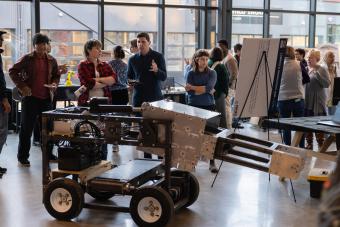
Adam Solovay, master's degree student in space resources, shows off his moon trencher during the ProtoFund Showcase conducted at the Labriola Innovation Hub on December 8, 2025.
Adam Solovay knew the lunar trencher he was building was becoming an obsession when he started working on the project outside of class.
“I started building prototypes in my free time,” said Solovay, who is currently pursuing a master’s degree in space resources. “I built several smaller vehicles to test out different excavation mechanisms.”
The battery-powered trencher is designed to dig up lunar soil, known as regolith, home to vital resources like hydrogen, oxygen and water that are essential for rocket fuel and life support systems in space.
“I’ve been inspired by shows like Star Trek and The Expanse,” Solovay said. “I’ve dreamed of having the opportunity to explore and work in space, but unfortunately here we are more than 50 years after the first Moon landing, and we have regressed in our space exploration capability. It’s time we do better.”
Solovay’s prototype trencher has received financial support from the Protofund, a collaborative program offered by the Labriola Innovation Hub with support from faculty and mentors, and with funding from donations to the E&I Foundation Fund at Mines. The program awards students up to $500 in the first round of funding and up to $2,000 in the second to be used to build prototypes, and connects them with the resources, tools, and mentors they need to bring their ideas to reality.
Solovay has been developing his idea for a trencher since his undergraduate days at Stevens Institute of Technology. There, his senior design group developed a mining rover to go after simulated ice chunks buried in simulated regolith for the NASA Lunabotics competition.
Since then, he has continued to iterate on the idea, building multiple prototypes on his own time, including a wooden one that currently lives in the garage of his house in Colorado Springs.
Unlike a single shovel on a tractor-like device, Solovay’s trencher is designed to be able to excavate continuously, using paddles in a V-shaped pattern to pull the regolith on board the vehicle.
In some ways, it works like a combine harvester working in an agricultural field on Earth, Solovay said. Those vehicles collect grain and then offload it through a hopper to a hauling truck, which allows the combine to keep going without needing to stop to empty its collected contents.
“When digging holes with a single shovel, half your operation time is spent dumping what was just excavated,” he said. “The trencher has split the excavation and material offloading into two separate mechanisms and thus both can be done at the same time.”
Solovay has also spent time considering the lower gravity environment of the Moon and how his trencher can both be lightweight enough so it can be transported to the Moon while also staying put on the Moon’s surface as it does its work.
“The digging forces actually help anchor it to the ground because the trencher is pulling up from the ground and not pushing down like other machines,” he said. “A traditional excavator needs to be heavy to induce higher forces into the ground and regolith. The digging forces of the trencher can make up for the reduced weight of the vehicle.”
Solovay has used two rounds of ProtoFund money to purchase structural material and electric motors for his trencher’s digging mechanism and chassis.
“The Protofund’s support truly gave this project its foundation,” he said. “While the financial assistance was greatly appreciated, what I valued most was the meaningful mentorship from the program’s advisors. Their guidance and willingness to connect me with Mines faculty and staff made a tremendous difference, especially in navigating the fabrication and assembly process. I’m incredibly grateful for their time, insight and encouragement throughout this journey.”
To make the effort financially sustainable longterm, Solovay envisions using the trencher to help with the mining of Helium-3. He-3 is a fuel source used for fusion technology, refrigeration in quantum computers, medical devices and bomb detection equipment. He-3, which costs $20 million per kilogram, is not naturally found on Earth, so it must be created via synthesis. The gas is naturally present on the Moon.
During the spring semester, Solovay plans to start testing the trencher with the hope of one day building the lunar economy and advancing human civilization into the solar system.
“Adam is not only a brilliant student, but also an individual with remarkable initiative and entrepreneurial drive,” said Angel Abbud Madrid, director of the Space Resources Program at Mines and a mentor for Solovay. “During his studies in our Space Resources program, and while working full time, he has also been building a robotic excavator/trencher to operate on the lunar surface. Literally in his garage!”

About Mines
Colorado School of Mines is a public R1 research university focused on applied science and engineering, producing the talent, knowledge and innovations to serve industry and benefit society – all to create a more prosperous future.