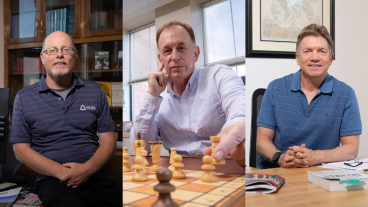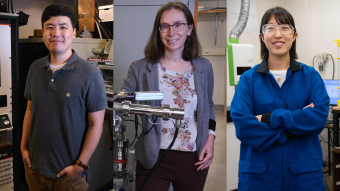
Lawrence Cho, Megan Holtz and Jihye Kim, assistant professors of Metallurgical and Materials Engineering at Colorado School of Mines, have been awarded National Science Foundation CAREER Awards to support their research on pressing materials challenges from ultrahigh-strength steel to critical minerals to quantum computing.
NSF CAREER Awards are given to early-career faculty who have the potential to be leaders and serve as academic role models in research and education. It is one of NSF’s most prestigious awards and supports activities that help researchers establish a foundation for a lifetime of leadership.
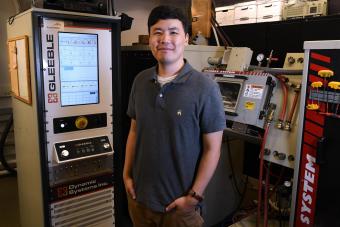
Lawrence Cho: Stronger steel for extreme conditions
Steel is used across industries in applications where strength is necessary for performance. But the energy, defense and transportation sectors increasingly need material that is not only strong but also tough enough to withstand demanding service conditions. Cho’s CAREER Award research is focused on designing and enhancing steel that can be used in dynamic impact conditions.
“Ultrahigh-strength steels are among the strongest commercial structural materials in use today. I focus on dynamic loading conditions where steel often becomes very brittle and fractures more easily. I am excited about this award because through this research we could demonstrate that there’s some evolution of steel science and technology, pushing the boundaries of performance under dynamic loading condition in particular and other extreme conditions in general,” he said.
Cho said he hopes the project will demonstrate how advances in computational tools and characterization methods can contribute to the continued evolution of steel science and metallurgical innovation. He’ll use modern computational tools, accelerated experimentation and advanced characterization to gain insight on how microscale features within ultrahigh-strength steels influence crack formation and fracture during dynamic loading – important data for the creation of steels with exceptional strength and superior toughness.
“With increasing strength, the common hypothesis is that the material loses ductility or toughness, so it becomes more brittle. Our previous research at the Advanced Steel Processing and Products Research Center (ASPPRC) shows that we can break through the strength/toughness trade-off through scalable and more energy-efficient processing approaches,” he said.
Industry partners, including steel manufacturers, and national laboratories will be involved in advanced characterization/testing and student mentoring. Cho said students working with him on the project will also connect with international researchers from an intelligent materials design lab in South Korea, who will lend their expertise in AI-driven alloy design.
“These collaborations mean that students will be able to get some multi-disciplinary and integrated mentorship while working on this project,” he said.
He also acknowledged that preparation of the proposal was supported through significant institutional guidance and mentorship from the Office of Research and Technology Transfer, the Office of Research Administration, the Trefny Innovative Instruction Center and senior faculty mentors at Mines.
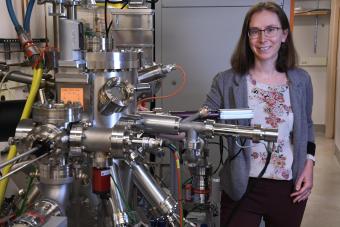
Megan Holtz: Atomic-level control of functional and quantum materials
As quantum and next-generation computing technologies grow, so will the need for researchers who understand materials at the atomic scale. Megan Holtz’s project aims to develop new methods to control and observe the arrangement of atoms at the smallest scales, to create new functional and quantum materials.
“It’s exciting to be on the edge of the unknown and what’s possible,” Holtz said. “Being able to create something new, to develop a new material for different properties and be able to see their structure on the smallest length scales – it’s a really powerful aspect of this research.”
The materials at the center of Holtz’s NSF CAREER Award are hexagonal oxides, which possess electrical and magnetic properties that hold potential for energy-efficient computer memory, microelectronics and quantum device architectures. By controlling the disorder in the material with interfaces, chemical variations and local symmetry, her research aims to stabilize new phases and properties of these materials.
“Using a molecular beam epitaxy thin film deposition system, we grow crystals, atomic layer by atomic layer, with really high precision. That means we can design materials at the smallest scales to optimize their properties,” Holtz said. “Once we’ve grown these materials, we use advanced electron microscopy techniques to be able to determine their atomic structure at interfaces, defects and domains.”
Synthesizing these pristine atomic structures is only half the battle; Holtz and her team must also visualize how individual atoms behave near disorder. To achieve this, researchers will leverage cutting-edge electron microscopy techniques, including scanning nanobeam electron diffraction. This tool allows researchers to collect a complete diffraction pattern at every single pixel of an image, mapping local polarizations, structural domains and strain profiles.
As part of the project, Holtz will host three-day summer workshops to teach undergraduate and early graduate students about these microscopy techniques, allowing them to begin similar research on their own.
“Being able to share knowledge of these cutting-edge techniques and science, and bringing it to the forefront of students’ minds, can inspire them to carry on with this kind of research going forward,” she said.
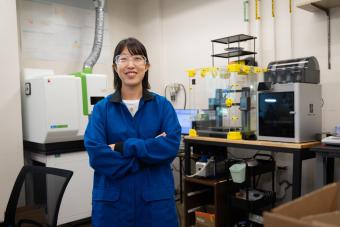
Jihye Kim: Extracting critical minerals from waste
Increasing demand for critical minerals requires innovative ways to acquire them – and that includes recycling things that have reached the end of their useful lives.
Jihye Kim is developing a process that combines advanced electrochemical methods with conventional hydrometallurgical processes in order to selectively recover critical materials from complex secondary feedstocks. While end-of-life lithium ion batteries serve as the model system for the project, the underlying scientific principles are broadly applicable to many critical mineral extraction, refining, and recycling processes. By controlling electrochemical conditions during leaching, Kim aims to better understand how different metals dissolve and interact with their surrounding chemical environment. The knowledge gained will help scientists and engineers design extraction processes that improve metal selectivity, reuse the electrolyte multiple times and reduce chemical and energy consumption involved in extraction, Kim said.
“Electrochemically assisted leaching is attracting growing interest because it offers a fundamentally different way to control how metals dissolve and separate,” Kim said. “This project will help us establish the scientific understanding needed to design more selective and efficient extraction processes. It has the potential to be scaled and change the paradigm of critical metals recovery from complex feedstocks,” Kim said.
Kim teaches a junior-level metallurgical and materials engineering course that focuses on extractive metallurgy. She plans to incorporate some of the research concepts and laboratory methods developed through the project into the lab component of the course, giving students hands-on experience with emerging extraction technologies. Kim said she’ll also be setting up a portable demonstration of the electrochemical methods from the project that can be brought to outreach events to engage with high school students, conference audiences and more.
Mines’ interdisciplinary nature has been essential to the project, Kim said.
“There are many experts in this area across campus, and several have graciously agreed to be a technical advisory committee member and read through the reports coming out of this project and provide guidance,” Kim said. “The Shared Instrumentation Facility and the MME facilities we have on campus are a critical component as well. A significant portion of this project relies on the advanced characterization capabilities they provide, and without those, much of this work would not be possible.”

About Mines
Colorado School of Mines is a public R1 research university focused on applied science and engineering, producing the talent, knowledge and innovations to serve industry and benefit society – all to create a more prosperous future.